




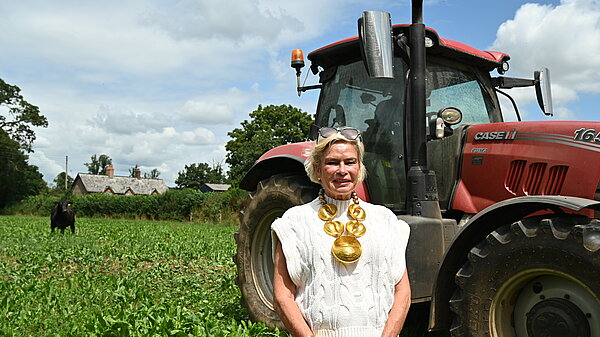
Rachel Clare Gilmour (née Oliver) was born on 13 October 1964 and raised on the picturesque Somerset-Devon border, the region she now proudly represents. Her father, David Wrench, a former England rugby player and Conservative council leader, imbued her with a deep appreciation for public service and community values. Gilmour’s early education was split between local public schools and Cheltenham Ladies’ College, reflecting both her rural roots and social adaptability.
Her academic pursuits led her to SOAS University of London for law and King’s College London for English literature, nurturing a multidisciplinary foundation that would serve her future legislative work.
Table of Contents
Early Life & Education
Rachel Clare Gilmour (née Oliver) was born on 13 October 1964.
She is the daughter of David Wrench, a former England international rugby player, later leader of Wellington Town Council and Conservative party member. Rachel grew up on the Somerset–Devon border.
Her schooling: she attended local primary schools (e.g. St John’s Primary in Wellington) and later Cheltenham Ladies’ College privately, having won a scholarship. She joined the Liberal Party at age 17 while at Cheltenham.
Further education: she studied law at SOAS (School of Oriental & African Studies), University of London, and then English Literature at King’s College London.
Career Before Westminster
Rachel Gilmour built a diverse professional background before becoming MP:
She was an English lecturer at Somerset College of Arts & Technology in Taunton.
She then moved into communications, working for national/international NGOs.
Notably, she became Director of Communications at the National Farmers’ Union (NFU), and was the first woman in 100 years to join the NFU board.
Later, she was Head of Strategy at the Environment Agency.
More recently before her election, she worked as Director of Communications for Pangea 21, a group of health tech startups.
Local Political Service & Campaign Experience
Rachel has been involved in local politics for many years. She served on Taunton Deane Borough Council, and also represents Clare & Shuttern ward on Mid Devon District Council.
She launched her campaign to be MP for the newly created constituency of Tiverton and Minehead in January 2024. In her campaign launch at Dulverton Town Hall, she set out core campaign issues including cost-of-living, local healthcare, protecting the environment, and local jobs.
Her campaign was grassroots in many respects: visiting thousands of homes, meeting residents across towns, villages and hamlets of the constituency to understand their concerns.
2024 General Election & Victory in Tiverton & Minehead
The constituency Tiverton and Minehead is newly established (from the 2023 Periodic Review of Westminster constituencies), combining areas of Devon and Somerset.
On 4 July 2024, Rachel Gilmour was elected as the first MP for Tiverton & Minehead.
She won with 18,326 votes (~38.6%), defeating Conservative incumbent Ian Liddell-Grainger (from the abolished Bridgwater & West Somerset seat) who got ~14,819 votes (~31.2%). Reform UK, Labour, and Green candidates trailed.
Her majority was 3,507 votes (≈7.4%).
Turnout in the constituency was ~65.9%.
Political Identity, Values & Priorities
Rachel Gilmour’s politics draw strongly from her rural background, environmental concern, and community service. Some of her defined values:
Local representation: She emphasises listening, visibility, being active across her large rural constituency (coast, moorland, villages) and not being a distant MP.
Protection of public services: especially healthcare (local community hospitals, NHS performance), broadband and transport connectivity, mental health, etc.
Environment & rural livelihoods: Her experience at the NFU and Environment Agency feeds into her commitment to protecting waterways, supporting farmers, combating climate change, flood defences, green spaces.
Cost of living: A strong concern, particularly as it affects rural, coastal, elderly, low-income residents; issues such as housing energy costs, fuel, services.
Crime, public safety and transport: rural public safety (antisocial behaviour, shoplifting), and transport links (both buses and trains) have been flagged as priorities.
Key Policy Campaigns & Parliamentary Activity
Since being elected, she has been active on several issues:
Transport improvements: In her first 100 days, she has made local transport a top priority, working with advisors to look at improved bus and train services.
Health / NHS: She has called for the NHS to be top priority in the national budget, highlighting that local hospital trusts have missed cancer treatment waiting-time targets.
Environment / pollution: For instance, she raised concerns in Parliament over the use of flea treatments (“spot-on” treatments like fipronil, imidacloprid) whose runoff is harming waterways, and called for stricter regulation.
Constituency access & local services: She regularly holds surgeries, meets with local residents, is campaigning for expansion of local nurseries and better bus routes.
Constituency Issues: What She’s Tackling Locally
Tiverton & Minehead is a large rural/part-rural constituency, with specific issues:
Healthcare services: local hospitals, delays in cancer treatment, access to dental services, ensuring community hospital facilities are preserved.
Transport: rural bus services are often thin on frequency; train services and connections can be inconvenient; many remote villages have poor public transport.
Cost of living & energy efficiency: especially in older rural homes, heating, insulation, fuel costs.
Environment & flooding: rural waterway health, flood risk, protecting green spaces etc.
Rural crime & safety: issues like antisocial behaviour, shoplifting, local policing presence.
First 100 Days / Early Achievements
In her first 100 days, Rachel and her team have responded to hundreds of casework issues from constituents, holding surgeries in multiple towns/villages.
She has already begun advocacy in Parliament on local transport, health service delivery, and environmental risk.
She has made her maiden speech (in October 2024) which included pointing out the severe limitations in travel links experienced by people in her large constituency.
Controversies & Criticisms
In January 2025, she referred herself to the Parliamentary Commissioner for Standards after it emerged she had made her son one of her staff team (though in a voluntary capacity).
She also stirred local discussion by commenting that Butlin’s (a holiday camp company) is “partly” to blame for low social mobility in her constituency, citing that many local jobs offered require no qualifications. Some saw this as a bold observation; others found it controversial.
In March 2025, there was a report that during a visit to Hinkley Point power station, she was abusive to a security guard when told her driving licence was expired, etc. She denied the allegations.
In July 2025, she submitted an expenses claim for a pub meal (chips, halloumi wrap, hot drink, half-pint cider) for ~£11.81 in December 2024, which was subsequently rejected. While a small claim, this is sometimes cited by critics.
These controversies are relatively minor in scale compared to some national issues, but have local traction and reflect the scrutiny MPs are under.
What Lies Ahead: Challenges & Opportunities
Opportunities:
Consolidating support in a large, newly drawn constituency. The boundary changes (2023) create opportunity to build a strong local presence.
Push for improved local services may yield visible gains (transport, health, environmental protections) that resonate.
As the constituency is partly rural and coastal, environmental / flood / climate adaptation work may become increasingly important, and likely to attract both public concern and central funding.
Building on trust via constituency surgeries, responsiveness, local visibility could help in cementing loyalty beyond just the initial win.
Challenges:
Delivering improvements under constraints: NHS waiting times, transport services, budget limitations. Lots of rural constituencies are suffering from underinvestment; change may be slow.
Managing expectations: as a new MP, constituents may expect rapid changes; balancing immediate wins vs long-term structural issues (like rural connectivity or systemic health investment) will be demanding.
Opposition & pushback: from Conservative opponents locally, local media, from governmental departments. Also managing internal liberal democrat priorities and national party direction.
Dealing with controversies: even small matters (expenses, alleged behaviour) can become amplifiers for criticism; will need good communication and accountability.
FAQs
Q1: Who is Rachel Gilmour?
A: Rachel Gilmour (née Oliver) is a Liberal Democrat politician, born 13 October 1964. She became Member of Parliament for the newly created constituency of Tiverton and Minehead in the 2024 general election.
Q2: What is her majority and vote share?
A: She won with a majority of 3,507 votes (~7.4%) in the 2024 general election. Her vote share was about 38.6%.
Q3: What was her background before becoming MP?
A: She worked in education (lecturer), then in communications/public affairs — for NGOs, the National Farmers’ Union, the Environment Agency, and health-tech startups. She also had local council service (Taunton Deane Borough, Mid Devon District).
Q4: What issues does she prioritize?
A: Key issues include local health services (access, NHS performance), transport improvements, environment (pollution, waterways, flood defences), cost of living, crime/public safety in rural areas, protecting community hospitals, and ensuring rural voices are heard.
Q5: What has she done so far as MP?
A: Among her early actions: pushing for local transport services improvements; raising NHS and cancer treatment target misses; calling for stricter regulation of chemicals harming waterways; engaging in extensive constituency casework; making her maiden speech; holding regular surgeries; advocating in Parliament for local interests.
Q6: Are there any controversies tied to her?
A: Yes: making her son part of her staff team (in a voluntary role) leading to a self referral to Standards Commissioner; remarks about social mobility and employers like Butlin’s; a reported incident at Hinkley Point over licence expiry (which she denies); a small rejected expense claim.
Q7: What is the constituency of Tiverton & Minehead like?
A: It is newly created in 2023, combining parts of Devon and Somerset. It includes rural towns, coastal communities, villages, countryside and moorlands. Many areas are remote, with challenges in transport, access to services, and environmental exposure.
Q8: How is she seen politically? What makes her stand out?
A: She stands out for her deep local roots (having grown up in the wider area), her professional experience relevant to rural/environmental issues, and her campaign style of listening and being visible across the constituency. Plus her victory in a new seat over an established Conservative MP adds to her profile. She also seems eager to make rural and environmental issues centre stage in her representation.
Q9: What is her contact / how does she engage with constituents?
A: She holds constituency surgeries in various towns and villages; published schedules. Also has outreach via her campaign and MP website. She is active in local meetings, listening sessions, etc.
Q10: What could be her future prospects?
A: If she can deliver visible improvements in key areas, she may solidify her hold on this new constituency. She might also gain prominence in her party on rural/environmental portfolios. If national political dynamics (e.g. polling, party leadership) shift, she could be a voice leveraged by the Lib Dems in shaping policy in these areas.
Conclusion
Rachel Gilmour election as MP for Tiverton & Minehead marks a turning point for a constituency newly re-drawn, combining very rural, remote, coastal, and agricultural areas. Her mix of experience (in environment, farmers’ interests, communications) pairs well with the constituency’s needs. Early in her term she has already shown a strong emphasis on local issues: health, transport, environment, cost of living.
The test for her will be converting those priorities into tangible improvements for residents — e.g. better public transport, more efficient health services, flood resilience, better environmental protections. Given the majority of ~3,500 she holds, her political seat is not impregnable; delivery and visibility will matter. Her controversies so far are small but reminders that public scrutiny is real.