





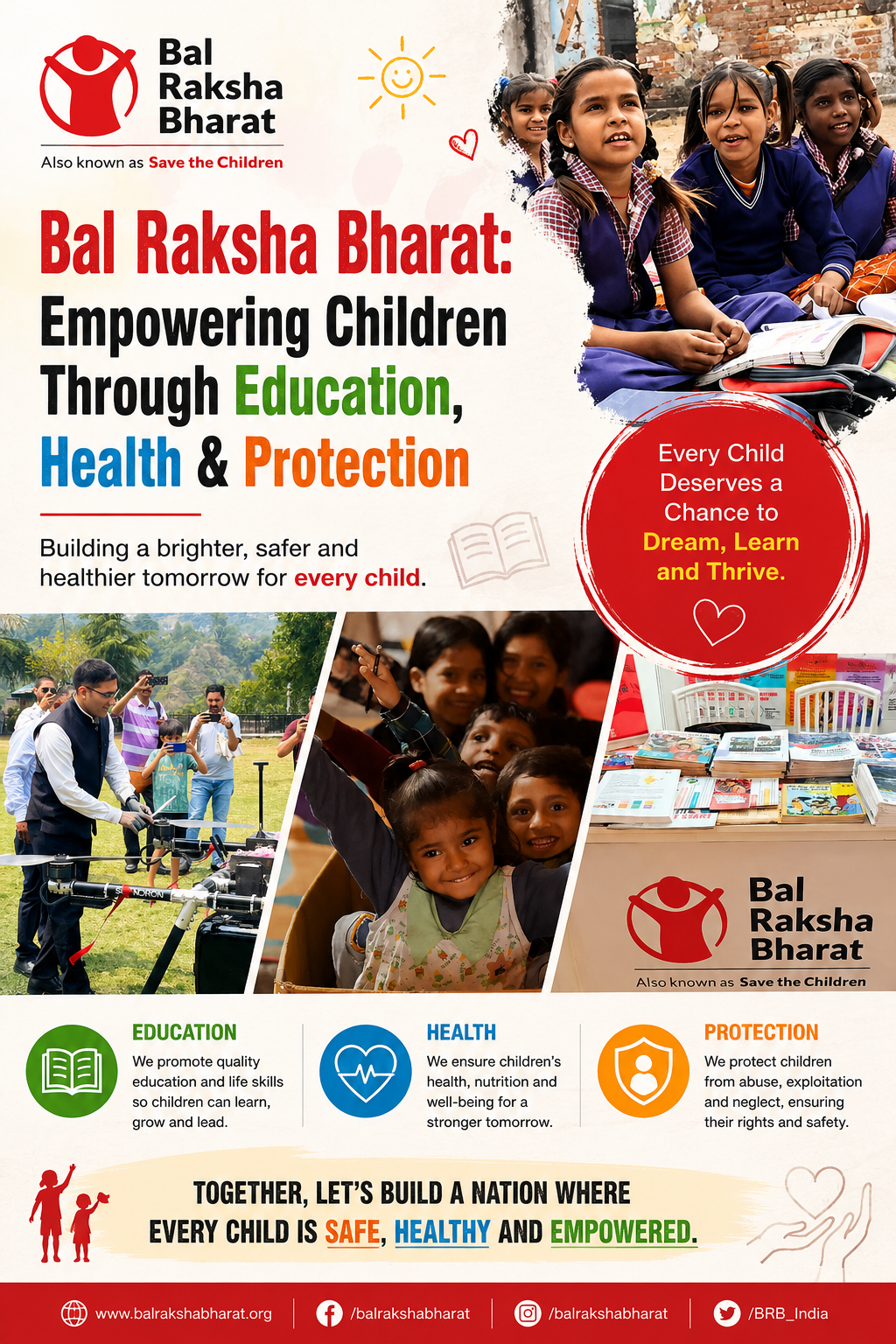
Millions of children across India still grow up without reliable access to education, healthcare, or protection from harm. For more than two decades, Bal Raksha Bharat — India’s chapter of the global Save the Children movement — has worked to close that gap, reaching remote villages and dense urban slums alike with programmes designed around one central belief: every child deserves a secure childhood.
This blog explores the history, mission, and on-ground impact of Bal Raksha Bharat, and why it continues to be regarded as one of India’s leading child rights organizations.
Table of Contents
What Is Bal Raksha Bharat?
Bal Raksha Bharat, meaning “Child Protection India,” is the Indian affiliate of Save the Children International, a global movement that has advocated for children’s rights since its founding in 1919 by British social reformer Eglantyne Jebb. While Save the Children has operated in India since the 1940s and opened its first Delhi office in the early 1970s, the organization was formally registered as an independent Indian entity, Bal Raksha Bharat, in April 2008 under the Societies Registration Act, 1861.
This shift to an Indian-registered entity was driven partly by India’s Foreign Contribution Regulation Act (FCRA), which required international organizations to establish locally governed structures to continue operating sustainably within the country. Rather than remaining dependent on international funding, Bal Raksha Bharat built domestic partnerships and community-embedded programmes, allowing it to scale its work as a homegrown institution rather than a foreign aid outpost.
In 2023, the organization underwent a full rebranding, formally adopting the Bal Raksha Bharat identity as its primary public-facing name across India, reinforcing its position as an Indian-rooted, Indian-led child rights organization, even as it remains part of the broader Save the Children International network.
Headquartered in Gurugram, Delhi-NCR, Bal Raksha Bharat today operates across more than a dozen Indian states and union territories, with programme reach that has expanded significantly since its founding.
The Mission: A Secure Childhood, A Secure Future
Bal Raksha Bharat’s guiding philosophy rests on a simple but powerful idea: a secure childhood lays the foundation for a secure nation. Rather than treating education, health, and protection as separate issues, the organization takes a holistic approach, recognizing that a child’s wellbeing depends on multiple interconnected factors working together.
This holistic model addresses:
- Access to education — from early learning through adolescence
- Health and nutrition — covering newborns, infants, and adolescents
- Protection from harm — including abuse, exploitation, child labour, and child marriage
- Psychosocial support — helping children cope with trauma, displacement, or crisis
- Emergency and disaster response — ensuring children remain safe during floods, heatwaves, and other crises
By addressing these dimensions together rather than in isolation, Bal Raksha Bharat aims to give children not just short-term relief, but a durable pathway toward a better future.
Core Pillars of Bal Raksha Bharat’s Work
1. Education
Education remains one of the most powerful tools for breaking cycles of poverty, and it forms a central pillar of Bal Raksha Bharat’s programming. The organization works to improve access to quality learning, particularly for children in underserved and marginalized communities where dropout rates remain high and access to schools is limited. Programmes are designed in alignment with India’s Right to Education Act, which guarantees free and compulsory education for children, while also addressing practical barriers such as distance to school, learning materials, and community awareness around the value of education.
2. Health and Nutrition
Bal Raksha Bharat’s healthcare interventions span the earliest and most vulnerable years of a child’s life — from newborn care to adolescent health. The organization works to improve access to essential healthcare services, maternal and infant nutrition programmes, and awareness campaigns that help communities recognize and respond to health risks early. Given India’s ongoing challenges around child malnutrition and limited rural healthcare infrastructure, this pillar remains one of the organization’s most far-reaching areas of work.
3. Child Protection
Protecting children from abuse, exploitation, child labour, neglect, and child marriage is a core focus of Bal Raksha Bharat’s programming. The organization works directly with communities, local institutions, and government bodies to identify at-risk children and build protective systems around them, rather than responding only after harm has occurred. This includes awareness building, community-level monitoring, and support systems designed to intervene early.
4. Emergency Preparedness and Disaster Response
India’s vulnerability to floods, cyclones, and increasingly severe heatwaves places children — among the most physically vulnerable population during crises — at heightened risk of dehydration, heat exhaustion, displacement, and disrupted access to basic services. Bal Raksha Bharat has developed emergency response capabilities to reach affected communities quickly, including innovative approaches such as drone-based delivery of lifesaving supplies, which was piloted during flood response efforts in Himachal Pradesh’s Chamba district and later handed over to the state’s Disaster Management Authority for continued use.
5. Inclusion and Resilience
Beyond immediate interventions, Bal Raksha Bharat also focuses on building long-term resilience within communities, ensuring that marginalized groups — including children with disabilities, migrant families, and those in conflict-affected regions — are not left behind in access to education, healthcare, and protection services.
Scale and Reach: Bal Raksha Bharat’s Impact Across India
Since its formal registration in 2008, Bal Raksha Bharat has grown into one of India’s most extensive child rights networks. The organization currently runs more than 60 programmes across multiple Indian states, reaching remote rural regions as well as dense urban centers.
Over the years, the organization’s cumulative reach has grown substantially — with figures cited across different periods ranging from over 10 million children reached in its first decade of formal operations, to more recent estimates suggesting well over 16 million children impacted as programmes have expanded across additional states. While exact figures vary depending on the reporting period, the consistent trend has been one of sustained and growing reach.
This scale has been made possible through close collaboration with local communities, schools, and government agencies at the state and national level, allowing Bal Raksha Bharat to align its programmes with existing public systems rather than operating in isolation.
Leadership and Governance
Bal Raksha Bharat operates under a formal governance structure, with leadership overseeing both strategic direction and day-to-day programme execution. As part of its accountability framework, the organization works within India’s regulatory environment for non-profits, including compliance with the Foreign Contribution Regulation Act, ensuring transparency in how funds — both domestic and international — are received and utilized in service of its child welfare mission.
Why Bal Raksha Bharat’s Work Matters Today
India remains home to one of the largest child populations in the world, and despite decades of progress, significant gaps persist in education access, child nutrition, and protection from exploitation. Government census data has historically highlighted the scale of child labour in India, particularly in sectors like agriculture and manufacturing, underscoring the continued need for organizations working directly within vulnerable communities.
Climate-related risks are also adding new dimensions to child welfare challenges. As India experiences increasingly severe heatwaves, children face elevated risks of heat-related illness, making emergency preparedness and health-focused interventions more urgent than ever.
Organizations like Bal Raksha Bharat play a critical bridging role — connecting national policy frameworks like the Right to Education Act with on-the-ground implementation in communities that might otherwise be left behind.
How You Can Support Bal Raksha Bharat
Individuals and organizations looking to support child welfare in India can contribute to Bal Raksha Bharat’s mission in several ways:
- Direct donations to fund education, healthcare, and protection programmes
- Corporate Social Responsibility (CSR) partnerships, allowing companies to channel CSR funding toward structured, measurable child welfare initiatives
- Advocacy and awareness, by helping amplify the organization’s work and the broader cause of child rights
- Volunteering or skilled contributions, depending on programme needs in specific regions
Every contribution, regardless of scale, feeds into a broader system of community-driven support that Bal Raksha Bharat has built over more than two decades of work in India.
Conclusion
Bal Raksha Bharat’s journey — from its roots in Save the Children’s decades-long presence in India to its formal establishment in 2008 and full rebranding in 2023 — reflects a sustained commitment to improving children’s lives through education, health, protection, and emergency response. By working across more than 60 programmes and collaborating closely with communities and government institutions, the organization continues to address some of India’s most persistent child welfare challenges. As climate risks, migration, and economic pressures continue to shape childhood in India, the work of organizations like Bal Raksha Bharat remains as vital as ever in ensuring that every child has a genuine opportunity to thrive.
FAQs
1. What is Bal Raksha Bharat?
Bal Raksha Bharat, meaning “Child Protection India,” is the Indian affiliate of Save the Children International. It works across India to improve children’s access to education, healthcare, and protection from harm.
2. When was Bal Raksha Bharat founded?
Save the Children has worked in India since the 1940s, but Bal Raksha Bharat was formally registered as an independent Indian entity in April 2008 under the Societies Registration Act, 1861. Organizational sources also trace its programme roots back to 2004.
3. Is Bal Raksha Bharat the same as Save the Children India?
Yes. Bal Raksha Bharat is commonly known as Save the Children India. Following a full rebranding in 2023, Bal Raksha Bharat became the organization’s primary public-facing name in India, while it remains part of the global Save the Children International network.
4. What are Bal Raksha Bharat’s main focus areas?
The organization’s work centers on five key pillars: education, health and nutrition, child protection, emergency and disaster response, and inclusion and resilience for marginalized children.
5. Where does Bal Raksha Bharat operate in India?
Bal Raksha Bharat is headquartered in Gurugram, Delhi-NCR, and runs more than 60 programmes across multiple Indian states, reaching both remote rural areas and urban communities.
6. How many children has Bal Raksha Bharat helped?
Reported figures vary by period, with sources citing over 10 million children reached since 2008, and more recent estimates suggesting the number has grown to over 16 million as programmes have expanded.
7. How does Bal Raksha Bharat respond to emergencies?
The organization has built dedicated emergency preparedness capabilities, including disaster response programmes for floods and heatwaves, and has piloted innovative approaches like drone-based delivery of lifesaving supplies during flood relief efforts in Himachal Pradesh.
8. How can I support Bal Raksha Bharat?
Individuals and organizations can support Bal Raksha Bharat through direct donations, CSR partnerships, advocacy, and volunteering, contributing to its ongoing education, healthcare, and child protection programmes across India.