







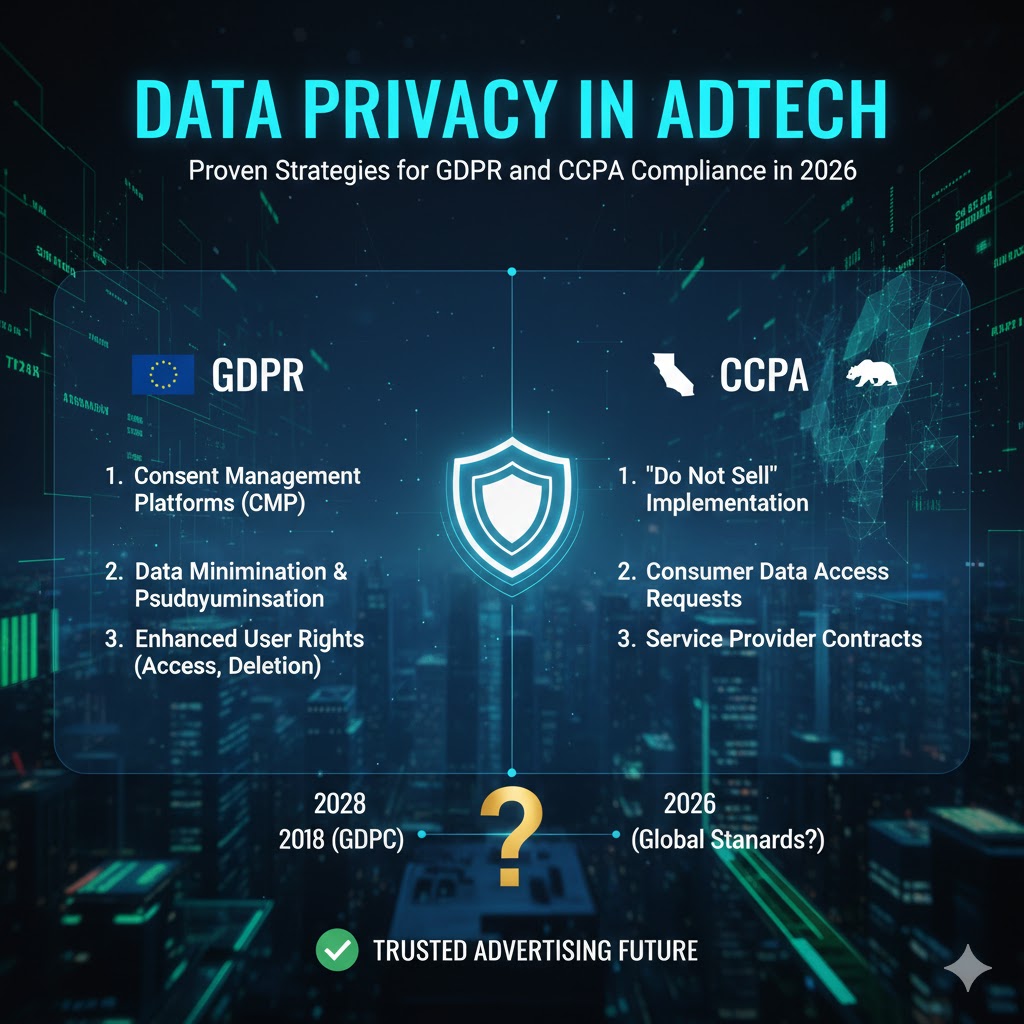
The digital advertising ecosystem has evolved rapidly over the past decade. From simple banner ads to hyper-personalized programmatic campaigns powered by artificial intelligence, AdTech has become one of the most data-driven industries in the world.
However, with innovation comes responsibility.
Governments and regulators across the globe have introduced strict data privacy regulations to protect consumers from misuse of personal information. Two of the most influential privacy laws shaping the AdTech industry are:
General Data Protection Regulation (GDPR)
California Consumer Privacy Act (CCPA)
These regulations have transformed how advertisers, publishers, and technology providers collect, process, and store user data.
For AdTech companies, compliance is no longer optional — it is essential for survival.
In this comprehensive 2026 guide, we will explore:
The fundamentals of data privacy in AdTech
Core requirements of GDPR and CCPA
Practical compliance strategies
Consent management frameworks
Data governance best practices
Risk mitigation tactics
Future privacy trends
Let’s dive deep into the world of privacy-first advertising.
Table of Contents
Understanding Data Privacy in AdTech
What Is AdTech?
Advertising Technology (AdTech) refers to software and tools that help brands and agencies deliver digital ads to targeted audiences. This ecosystem includes:
Demand-Side Platforms (DSPs)
Supply-Side Platforms (SSPs)
Data Management Platforms (DMPs)
Customer Data Platforms (CDPs)
Ad Exchanges
Programmatic buying systems
These systems rely heavily on user data such as:
Browsing history
Device identifiers
Location data
IP addresses
Behavioral patterns
Purchase history
Why Data Privacy Is a Big Concern
The AdTech ecosystem operates through complex data-sharing chains. A single ad impression may involve:
Publisher
Ad exchange
DSP
SSP
Data broker
Analytics provider
Without strict privacy controls, user data can be exposed, misused, or processed without proper consent.
Data breaches, misuse of third-party cookies, and unauthorized tracking have raised serious concerns among consumers and regulators.
Overview of GDPR
What Is GDPR?
The General Data Protection Regulation came into effect on May 25, 2018. It applies to:
Any company operating in the European Union
Any organization processing EU citizens’ personal data
Even companies outside Europe must comply if they target EU users.
Key GDPR Principles
Lawfulness, fairness, and transparency
Purpose limitation
Data minimization
Accuracy
Storage limitation
Integrity and confidentiality
Accountability
GDPR Requirements for AdTech
Explicit user consent before tracking
Clear privacy notices
Data Processing Agreements (DPAs)
Right to access data
Right to be forgotten
Data portability
72-hour breach notification
Non-compliance penalties can reach €20 million or 4% of global annual turnover.
Overview of CCPA
What Is CCPA?
The California Consumer Privacy Act came into effect on January 1, 2020. It applies to businesses that:
Operate in California
Meet revenue or data volume thresholds
In 2023, enforcement was strengthened under the California Privacy Rights Act (CPRA).
Key Consumer Rights Under CCPA
Right to know what data is collected
Right to delete personal information
Right to opt out of data sales
Right to non-discrimination
Unlike GDPR, CCPA operates more on an opt-out model rather than explicit opt-in consent.
GDPR vs CCPA: Key Differences for AdTech
| Feature | GDPR | CCPA |
|---|---|---|
| Consent Model | Opt-in | Opt-out |
| Geographic Scope | EU | California |
| Fines | Up to 4% global revenue | $7,500 per violation |
| Data Sales Definition | Broader | Specifically defined |
| Data Subject Rights | Extensive | More limited |
Understanding these differences is critical for global AdTech platforms.
Core Compliance Challenges in AdTech
1. Complex Data Supply Chains
AdTech relies on real-time bidding (RTB). During a single ad auction, user data may be transmitted to multiple vendors in milliseconds.
Tracking and documenting each data processor is challenging.
2. Third-Party Cookies and Tracking
With browsers like Chrome phasing out third-party cookies, companies must redesign tracking strategies.
3. Cross-Border Data Transfers
Transferring data outside the EU requires additional safeguards such as Standard Contractual Clauses (SCCs).
4. Consent Signal Synchronization
Ensuring consent signals are properly transmitted across platforms remains a technical challenge.
Proven Strategies for GDPR and CCPA Compliance
1. Implement a Robust Consent Management Platform (CMP)
A CMP helps:
Display consent banners
Record user preferences
Store consent logs
Sync consent signals with vendors
CMPs should support:
Granular consent options
Easy withdrawal mechanisms
Audit trails
2. Adopt Privacy by Design
Privacy must be integrated at every development stage:
Minimize data collection
Use anonymization or pseudonymization
Limit access controls
Encrypt data at rest and in transit
Privacy by design is mandatory under GDPR.
3. Conduct Data Mapping and Audits
AdTech companies should:
Identify all personal data collected
Map data flows
Document third-party processors
Review retention policies
Regular audits reduce compliance risk.
4. Strengthen Vendor Management
Since AdTech involves multiple partners:
Sign Data Processing Agreements (DPAs)
Assess vendor compliance
Conduct risk assessments
Monitor subcontractors
Vendor risk is one of the biggest enforcement triggers.
5. Enable User Rights Automation
Create automated workflows for:
Access requests
Deletion requests
Data portability requests
Opt-out mechanisms
Manual handling increases risk and inefficiency.
6. Update Privacy Policies Transparently
Your privacy policy should clearly explain:
What data is collected
Why it is collected
How long it is retained
Who receives it
User rights
Transparency builds user trust.
7. Strengthen Data Security Infrastructure
Security best practices include:
End-to-end encryption
Multi-factor authentication
Role-based access control
Regular penetration testing
Incident response planning
Real-Time Bidding (RTB) and Privacy
Real-Time Bidding presents unique risks:
Broadcasting user data to multiple bidders
Lack of full control over downstream processing
Difficulty ensuring lawful basis
Strategies:
Limit bid request data fields
Avoid transmitting precise location data
Use contextual targeting instead of behavioral profiling
First-Party Data Strategy in 2026
With third-party cookies declining, first-party data is becoming central.
Benefits:
Greater control
Higher compliance confidence
Stronger customer relationships
Tactics:
Loyalty programs
Email marketing
Subscription models
CRM integration
The Role of Contextual Advertising
Contextual targeting analyzes webpage content rather than user identity.
Advantages:
No personal data required
GDPR-friendly
CCPA-safe
Lower compliance risk
In 2026, contextual AI is rapidly replacing invasive behavioral tracking.
Data Anonymization and Pseudonymization
Under GDPR:
Anonymized data falls outside regulation
Pseudonymized data remains regulated but reduces risk
AdTech companies should:
Remove direct identifiers
Hash device IDs
Aggregate datasets
Handling Data Breaches
In case of a breach:
Under GDPR:
Notify regulators within 72 hours
Inform affected individuals
Under CCPA:
Civil penalties may apply
Consumer lawsuits possible
Prepare:
Incident response plan
Communication templates
Forensic investigation process
Cross-Border Data Transfer Strategies
To legally transfer EU data:
Standard Contractual Clauses (SCCs)
Data Transfer Impact Assessments (DTIAs)
Localized EU data storage
Cloud infrastructure must align with regulatory standards.
Emerging Trends in Privacy and AdTech (2026)
1. Cookieless Advertising
Browser-led privacy initiatives are redefining digital advertising.
2. AI and Privacy Governance
AI-powered targeting requires:
Transparent algorithm documentation
Bias audits
Ethical data sourcing
3. Global Privacy Regulations
Beyond GDPR and CCPA:
India’s Digital Personal Data Protection Act
Brazil’s LGPD
Canada’s CPPA proposal
Privacy compliance is becoming global.
Building a Privacy-First AdTech Culture
Compliance isn’t just legal — it’s cultural.
Organizations should:
Train employees regularly
Appoint Data Protection Officers (DPOs)
Conduct privacy workshops
Promote ethical advertising values
Cost of Non-Compliance
Risks include:
Heavy fines
Lawsuits
Brand damage
Loss of advertiser trust
Revenue decline
In 2026, privacy violations spread rapidly via social media, making reputational risk enormous.
Step-by-Step GDPR & CCPA Compliance Checklist
Step 1: Audit Data Collection
Step 2: Identify Lawful Basis
Step 3: Deploy CMP
Step 4: Update Contracts
Step 5: Implement Security Controls
Step 6: Enable User Rights
Step 7: Train Teams
Step 8: Monitor Regulatory Updates
Conclusion: The Future of Privacy in AdTech
Data privacy is not the end of digital advertising.
It is the beginning of responsible, sustainable marketing.
AdTech companies that:
Embrace transparency
Prioritize consent
Invest in security
Shift toward contextual and first-party strategies
… will thrive in the privacy-first era.
GDPR and CCPA compliance should not be seen as obstacles but as opportunities to build trust-driven digital ecosystems.
The brands that win in 2026 are those that respect user data.
Frequently Asked Questions (FAQs)
1. What is the biggest privacy challenge in AdTech?
The complexity of real-time bidding and third-party data sharing makes compliance difficult.
2. Is CCPA stricter than GDPR?
GDPR is generally stricter due to its opt-in consent model and higher fines.
3. Does anonymized data fall under GDPR?
Fully anonymized data does not fall under GDPR.
4. What happens if an AdTech company violates GDPR?
Penalties can reach up to 4% of global annual turnover or €20 million.
5. How can AdTech companies prepare for cookieless advertising?
By investing in first-party data strategies, contextual targeting, and privacy-preserving technologies.
6. What is the difference between data controller and data processor?
A controller determines the purpose of processing, while a processor processes data on behalf of the controller.
7. Are small AdTech startups required to comply?
Yes, if they process EU or California resident data.