







In the early days of the internet, search was a simple game of keywords. If you typed in a service, you got a list of global results. Today, the internet is much more personal. When you search for anything from a plumber to a digital strategist, the search engine doesn’t just look at what you typed; it looks at where you are standing. This shift has significantly turned search visibility into a game of proximity. For any online marketing agency, mastering this geographic layer is the only way to ensure clients actually show up on the screens of local customers.
Table of Contents
What is GEO in Search Visibility?
GEO, also known as Generative Engine Optimization, is the process of refining the digital presence to align with AI-driven search and answer engines. It is no longer enough to rank for general terms. You need to rank for those terms in specific zip codes, cities, and regions. It is the art of telling search engines exactly which physical area your business serves so they can match you with nearby users.
Why GEO is the New Layer of SEO?
With the rising dependency on mobile browsing and voice search, the overall user intent is changing. Most people who are searching on their phones are looking for instant local solutions. Search engines have responded by adding a “geo-layer” to their ranking systems. Adding the layer helps to prioritize results that are physically close to the user. So, those who aren’t optimized for this layer are essentially invisible to the people closest to them.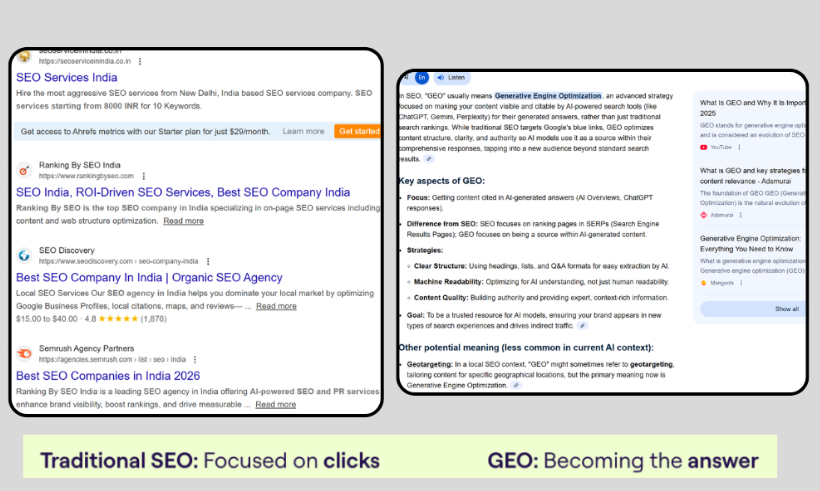
Key GEO Ranking Factors
To win at local search, you have to feed the algorithm the specific signals it craves. Here are the primary factors:
- IP Location: The search engine uses the user’s IP address to serve results relevant to their current city or neighborhood.
- Google Business Profile: Considered a key tool for local visibility. An optimized profile with reviews and photos is a massive signal of local relevance.
- Local Backlinks: Getting links from local newspapers, chambers of commerce, or nearby blogs proves to search engines that you are a trusted part of the local community.
- Language and Country Targeting: Using the correct hreflang tags and local dialects helps search engines direct the right regional traffic to your site.
- Mobile Search User Behavior: As major local searches tend to happen on the move, how users interact with your site on mobile, like clicking “call” or “get directions,” impacts your local standing.
How to rightly optimize a website for signals?
Standard strategies in SEO focuses on the “what,” but geo-optimization largely shifts focuses on “where.” Here is how an online marketing agency helps a brand bridge that gap:
- Create Location-Centric Landing Pages: Those serving in multiple cities must provide each one its own page. Don’t just swap the city name; include local landmarks and specific service details.
- Add Schema Mark-up: Adding the “Local Business” schema provides search engines with a highly structured data about your accurate address, phone number, and hours in a language they understand.
- Use a CDN (Content Delivery Network): A CDN stores your site on servers across the globe. This ensures that someone in your target city can load your site instantly, which is a major local ranking factor.
- Optimize Metadata and URLs for Location: Include clear city names in your title tags, meta descriptions, and even URL structures to signal clear geographic relevance.
- Match Content to suit local interests: Mention the local events, news, or community projects. The act will build authority as a local expert.
Tools for tracking GEO Performance
It is impossible to improve what cannot be measured. Rely on these efficient tools to see how you stack up in different locations:
- Google Search Console: It helps to see the “Countries” and “Pages” reports to understand the accurate source of traffic.
- Ahrefs /Semrush: Ideal for tracking keyword rankings across specific cities or regions.
- BrightLocal / Local Falcon: Best to have a grid view of the ranking in various spots across a city map.
- VPNs and SERP Simulators: These allow you to “spoof” your location so you can see exactly what a user in a different city sees when they search.
Why GEO Needs to Be Part of Your SEO Strategy?
Geo-targeting is the ultimate filter for modern search. By focusing on GEO signals, you reduce competition. Instead of fighting every company in the Country, you are only competing with those in your immediate area. The key takeaways are simple: stay consistent with your local data, create content that matters to your neighbours, and use technical tools to prove your location to the bots.
Frequently Asked Questions
Q1. What is Generative Engine Optimization in SEO?
Ans. It is the process of optimizing content so that AI-driven search engines can easily summarize and recommend your business.
Q2. How do GEO rank factors impact search results?
Ans. They act as a filter, prioritizing businesses physically close to the person performing the search.
Q3. What are some examples of geographic signals that SEO considers?
Ans. Common signals comprise the physical address, local phone area codes, and even mentions on other local websites.
Q4. How can I improve visibility in geo-based search results?
Ans. Keep your name, address, and contact number the same everywhere to improve visibility.
Q5. Is local SEO different from mobile-first local SEO?
Ans. Both are quite similar, but at some places there is a higher priority on page speed and easy-to-click buttons for directions or calling.
Q6. Do regional SEO strategies work for national businesses?
Ans. Yes, national brands use regional strategies to create a local feel at each branch location.
Q7. What tools help monitor GEO performances?
Ans. Certain tools such as Local Falcon, Google Search Console, and BrightLocal efficiently track the local map rankings.