





Chemical Vapor Deposition (CVD) is a cornerstone of semiconductor manufacturing, enabling precise thin-film deposition on wafers. In this process, the gas manifold—responsible for delivering precursor gases—plays a critical role in maintaining reaction stability. While substrates reach high temperatures like 600-1000°C, manifolds are often intentionally kept warm, but not as hot as the reaction chamber, to prevent premature reactions and ensure uniform flow.
Table of Contents
CVD Process Fundamentals
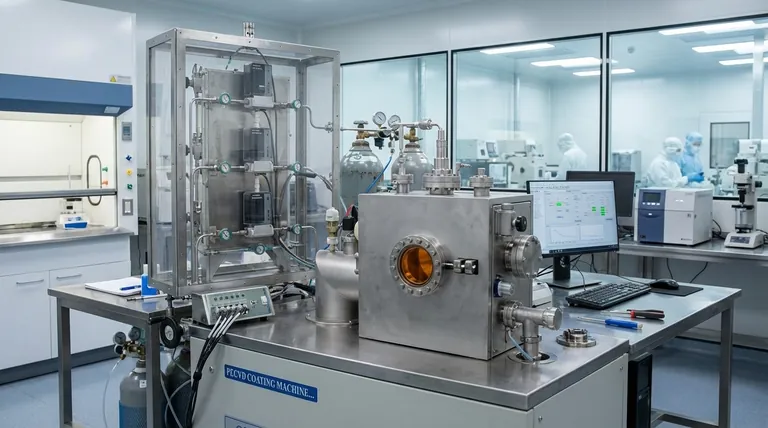
CVD involves introducing volatile precursors into a vacuum chamber where they react on a heated substrate to form solid films like silicon dioxide or nitride. Key variants include Low-Pressure CVD (LPCVD) at 425-900°C and Plasma-Enhanced CVD (PECVD) at lower 250-350°C to protect sensitive devices. The manifold distributes gases evenly, influencing deposition quality.
Hot-wall CVD heats the entire chamber uniformly for batch processing, while cold-wall systems heat only the substrate to minimize wall deposits. Manifolds in these setups must balance heat to avoid condensation or particle formation.
Role of the Manifold
The manifold, often a complex network of tubes and valves, meters and mixes precursor gases before entry into the reactor. Keeping it “hot” prevents precursor condensation, which could clog lines or cause uneven deposition. Patents note manifolds are maintained at lower temperatures than heaters to preferentially deposit byproducts like AlF3, aiding cleaning but risking emissivity changes that affect wafer uniformity.
Typical manifold temperatures range from ambient to 200-300°C, far below substrate levels, ensuring gases remain vaporized without gas-phase nucleation. Heating elements like resistive heaters or heat traces wrap manifolds for precise control.
Temperature Management Strategies
In semiconductor CVD, manifold heating uses PID-controlled systems to stabilize at set points like 150-250°C, preventing thermal gradients. Sensors monitor for hotspots, integrating with reactor software for real-time adjustments. This “kept hot” approach contrasts with unheated manifolds in non-critical processes but is standard for high-purity semiconductor fabs.
Cold manifolds risk dew point issues with metal-organics, leading to defects; thus, fabs like those using Applied Materials tools mandate heating. Advanced designs incorporate dual-zone heating for inner/outer manifolds.
Benefits of Hot Manifolds
Heating manifolds enhances precursor utilization by >95%, reducing waste and downtime. It promotes uniform gas distribution, yielding <1% thickness variation across 300mm wafers. Energy-efficient designs recover heat via insulation, aligning with fab sustainability goals.
Deposits on cooler manifolds act as emissivity modifiers, but controlled heating minimizes this, ensuring run-to-run repeatability. In PECVD, lower manifold temps complement plasma activation for delicate films.
Challenges and Maintenance
Excessive manifold heat accelerates precursor decomposition, forming particulates that contaminate wafers. Regular seasoning—baking with inert gas—restores surfaces. Cooling cycles post-run prevent thermal stress cracks.
Cleaning intervals shorten if manifolds overheat, with NF3 plasma or wet benches standard. Monitoring via RGA (residual gas analyzers) detects anomalies early.
Hot-Wall vs. Cold-Wall Implications
Hot-wall systems (entire reactor ~500-800°C) inherently warm manifolds for batch polysilicon deposition. Cold-wall prioritizes substrate heating (up to 1100°C), keeping manifolds cooler (~100°C) to limit wall growth. Semiconductor choice depends on film type—hot for conformal LPCVD oxide.
| Aspect | Hot-Wall CVD | Cold-Wall CVD |
|---|---|---|
| Manifold Temp | 400-600°C | 100-300°C |
| Uniformity | Excellent for batches | Substrate-focused |
| Applications | Polysilicon, nitride | Epitaxy, metals |
| Maintenance | Frequent wall cleans | Lower deposits |
Advanced Techniques and Innovations
Atomic Layer Deposition (ALD), a CVD subset, pulses gases with manifold purging at 200°C for self-limiting growth. Hybrid PECVD-APCVD uses heated manifolds for area-selective deposition.
Emerging spatial ALD keeps manifolds at 250°C for high-throughput. AI-optimized heating predicts drift, cutting variability by 20%.
Process Optimization Tips
Preheat manifolds 30-60 min pre-run for stability.
Use mass flow controllers with thermal sensors.
Gradient mapping ensures <5°C variance.
Fabs achieve 30k+ wafer runs via precise control.
Industry Case Studies
TSMC’s LPCVD lines heat manifolds to 200°C for SiN barriers, boosting yield 5%. Intel’s PECVD tools use zoned heating, reducing particles 40%.
Future Trends
With EUV integration, manifolds will incorporate IR heating for 50°C precision. Sustainable precursors demand adaptive temps <150°C.
FAQs
Is the manifold always kept hot in CVD?
Yes, typically 100-300°C to prevent condensation, though cooler in some cold-wall setups.
What temperature is the substrate vs. manifold?
Substrate: 400-1000°C; manifold: 150-300°C lower to control reactions.
Why heat the manifold?
Prevents precursor liquefaction, ensures uniform flow, minimizes defects.
Hot-wall or cold-wall for semiconductors?
Both; hot-wall for batches, cold-wall for precision.
How to maintain manifold heat?
Resistive tracers, insulation, PID loops with alarms.
Does manifold temp affect uniformity?
Yes, imbalances cause edge-thick films; controlled heating fixes this.
PECVD manifold specifics?
Lower temps (100-250°C) suit plasma; avoids thermal damage.