





In February 2026, OpenAI officially began testing advertisements inside its flagship AI chatbot, ChatGPT, for users in the United States — a notable pivot in how the company plans to monetize its widely used AI platform. This move signifies a substantial evolution from its previous stance of primarily subscription-based revenue and reflects broader trends in AI adoption and commercialization.
OpenAI has carefully positioned the test: ads will be clearly labeled, separate from ChatGPT’s responses, and limited initially to certain user tiers. Yet the implications extend well beyond labels on a page. From privacy concerns to advertising innovation and competitive responses from rivals, this rollout marks a pivotal moment in the evolution of AI services.
This article provides a deep dive into the why, what, how, and what’s next of this landmark change — covering technical features, user experience, business strategy, industry responses, advertising implications, and future scenarios.
Table of Contents
1. Why OpenAI Is Testing Ads in ChatGPT
1.1 The Economics of AI Services
Large-scale AI applications like ChatGPT require massive infrastructure support. Every interaction (text generation, image creation, tools access) requires computational power and server costs. While paid subscriptions (e.g., Plus, Pro) bring revenue, the vast majority of users are on free tiers. Advertising offers a way to subsidize infrastructure and maintain or improve free access without costing users directly.
1.2 Keeping AI Accessible
OpenAI has emphasized its mission to make AI widely accessible. Ads help support infrastructure without gating the product behind expensive subscriptions. By including low-cost and free users in the ad experiment, OpenAI aims to keep barrier-to-entry low while funding further development.
1.3 Market Strategy and Competitive Pressures
AI competitors (e.g., Anthropic’s Claude) have been promoting ad-free experiences, reflecting divergent monetization philosophies. OpenAI’s test also responds to mounting competitive and financial pressures, including rising infrastructure costs and expectations around future IPO or enterprise growth.
2. How the Ads Work: Features and Placement
2.1 Ad Eligibility and User Tiers
Ads are currently tested only in the United States and are shown to:
Free tier users
ChatGPT Go subscribers (roughly $8/month in the U.S.)
Users on higher tier plans — Plus, Pro, Business, Enterprise, and Education — remain ad-free.
2.2 Where Ads Appear
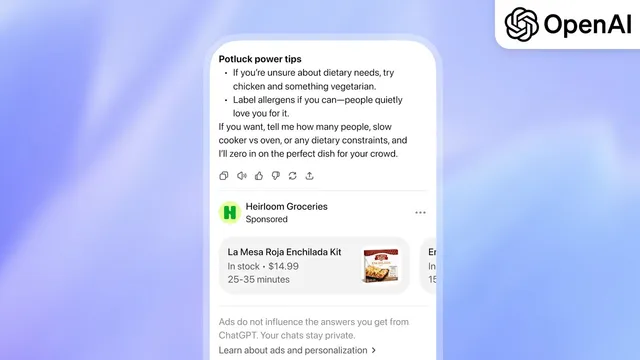
Ads are shown below ChatGPT’s generated responses, clearly labeled as “Sponsored” and visually separate from the AI’s output, ensuring they do not interfere with the answer itself.
2.3 Relevance and Personalization Controls
Ads are matched to the topic of the current chat and may use additional signals (such as ad interactions and chat history) for personalization — but only with user consent. Users can:
Turn off ad personalization
Dismiss ads
Clear ad data
See why a particular ad appeared
These controls aim to balance relevance with privacy.
2.4 Privacy and Data Safeguards
OpenAI has stated that:
Advertisers will not access user chats or personal data
Ads will not influence ChatGPT’s responses
Only aggregated performance data (e.g., views, clicks) is shared with advertisers
Ads will be excluded around sensitive topics (e.g., health, politics) and not shown to minors
This is key for trust, given ChatGPT’s role as a source of information.
3. The User Experience: What Changes for Users
3.1 Impact on Free Users
Users on the Free tier may see occasional ad placements with relevant sponsored content after their answers. While this represents a new visual element in the interface, OpenAI positions this as a tradeoff to maintain broad free access.
3.2 Paid Subscribers Get Ad-Free Experiences
Higher-tier users — Plus, Pro, Business, etc. — continue to have ad-free experiences as part of their premium subscription benefits. This maintains a clear incentive to upgrade for users who dislike ads.
3.3 Opt-Out and Control Features
Free users can opt out of personalized ads, dismiss individual ads, and provide feedback. Some opt-out methods (like reducing daily message limits) allow users to trade ad exposure for fewer free messages.
3.4 Avoiding Sensitive Contexts
Ads will not appear when discussing sensitive topics or in contexts where their presence could be inappropriate or disruptive.
4. Reactions From the Tech Community and Competitors
4.1 Industry Criticism and Debate
Competitors have leveraged OpenAI’s move as part of their marketing narrative. For example, Anthropic has publicly emphasized that its Claude chatbot will remain ad-free, framing ads as something that could undermine trust in AI assistants.
4.2 Privacy Advocates Raise Concerns
Some tech analysts and privacy observers have questioned whether ad integrations — even with limitations — could lead to broader data use implications or normalization of ads in conversational interfaces.
4.3 Community and User Opinions
Online discussions show a mix of reactions: some users accept ads if they help keep free access robust; others worry about future expansion of ads into other tiers or regions.
5. Advertising Opportunities: A New Channel for Brands
5.1 Contextual Advertising in AI Conversations
ChatGPT potentially offers advertisers a high-intent, contextually rich environment — ads could surface when users are actively researching or exploring a topic relevant to a brand’s offering.
5.2 Pilot Partners and Early Adoption
Major advertisers and agencies (e.g., Adobe, Omnicom) are participating in the early test program, offering valuable data for how conversational ads perform.
5.3 Measurement and Reporting
OpenAI’s aggregated performance metrics help advertisers evaluate how campaigns perform without compromising user privacy.
6. Potential Challenges and Risks
6.1 Consumer Backlash
Introducing ads to a service previously ad-free could trigger pushback from some user segments, especially if ads feel intrusive.
6.2 Maintaining Trust and Neutrality
Ads must remain clearly distinct from actual responses to ensure users can differentiate between AI-generated assistance and sponsored content. Missteps here could damage trust.
6.3 Competitive Threats
Rivals offering ad-free alternatives could attract users who prioritize a pure conversational experience.
6.4 Scalability and Global Expansion
U.S. testing is just the first step. Ad deployment internationally will require nuanced regulation compliance and user expectation management across regions.
7. Future Prospects: What’s Next After Testing
7.1 Broader Rollouts
If testing proves successful and well-received, OpenAI may expand ads to other geographic regions and explore additional ad formats.
7.2 Interactive and Conversational Ads
Long-term possibilities include interactive ads where users can ask follow-up questions or engage directly with sponsored content inside the chat window.
7.3 Evolving Monetization Models
Advertising could complement subscription revenue, balancing access and sustainability and potentially supporting new developer or enterprise offerings.
Conclusion
OpenAI’s move to test ads inside ChatGPT for U.S. users marks a watershed moment in the monetization of AI platforms. It attempts to blend accessibility, privacy, context-based advertising, and user choice. While ads are currently limited to select plans and regions, this step could have wide-ranging consequences — from how people use AI assistants to how brands allocate advertising budgets in the years ahead.
Ultimately, the success of this experiment will depend on user acceptance, clear boundaries between AI responses and ads, and maintaining trust without commercial compromise.
Frequently Asked Questions (FAQs)
Q1. Who will see ads in ChatGPT?
Ads are being tested for logged-in adult users in the United States on the Free tier and ChatGPT Go subscription plan. Paid plans such as Plus, Pro, Business, Enterprise, and Education are ad-free.
Q2. Will ads affect the quality of ChatGPT’s answers?
No. Ads are separate from ChatGPT’s responses and do not influence the content of the answers generated by the AI.
Q3. Does OpenAI share my chat conversations with advertisers?
OpenAI states it will not share chats, histories, memories, or personal data with advertisers. Only aggregated performance data such as views and clicks are shared.
Q4. Can I opt out of ads or personalization?
Yes. Users can disable ad personalization, dismiss ads, clear ad data, and see why an ad appeared in settings.
Q5. Why is OpenAI introducing ads now?
Advertising helps subsidize infrastructure costs and supports wider access to ChatGPT’s capabilities. It complements subscription revenue and reflects evolving monetization strategies.
Q6. Will ads appear in other countries?
Currently, the test is limited to the United States. Expansion to other regions could happen after the test concludes and based on feedback.