






MSN.com, the flagship web portal by Microsoft, has been a mainstay of the internet since 1995. What began as a dial-up service evolved into a global content destination visited by hundreds of millions every month. MSN’s transformation has paralleled the changing priorities and technologies of the digital era—from email and chat to mobile news curation, cloud integration, and AI-powered features in 2025. This comprehensive guide covers MSN.com’s origin story, major milestones, evolving technology, global popularity, and its enduring role in Microsoft’s digital vision.
Table of Contents
The Evolution of MSN.com
Birth of a Digital Giant (1995–2000)
MSN was launched August 24, 1995 as “The Microsoft Network”—a proprietary, subscription-based dial-up service bundled with Windows 95. Within three months, it amassed over 500,000 subscribers.
Early MSN featured curated forums, on-demand email, and exclusive content, standing toe-to-toe with AOL and CompuServe.
By 1996, demand for open web access led Microsoft to merge “MSN.com” with its “Internet Start” homepage, relaunching MSN as a free, ad-supported portal.
MSN quickly diversified to include original websites—MSN Money (investments), MSN Autos (car shopping), MSN Games (gaming), and travel (later spun off as Expedia).
The Golden Age (2000–2010): Messaging, Mail & More
MSN Messenger, launched in 1999, became the world’s leading instant messaging platform, hitting 330M active users by 2010.
MSN.com grew into a web super-hub, integrating Hotmail, news, shopping, and new entertainment feeds.
In 2005, Microsoft began consolidating websites under the “Windows Live” brand, tying email, chat, spaces (blogging), and storage (SkyDrive, now OneDrive) into a unified cloud experience.
The launch of Bing in 2009 integrated enhanced, AI-powered search directly into MSN.com, tying all content discovery to Microsoft’s in-house engine.
Modernization, Competition & Streamlining (2010–present)
Many legacy MSN services were shuttered or merged into Outlook.com, Skype, and Bing as Microsoft streamlined its consumer platforms circa 2013.
MSN Messenger was retired, with Skype replacing it as Microsoft’s messaging backbone.
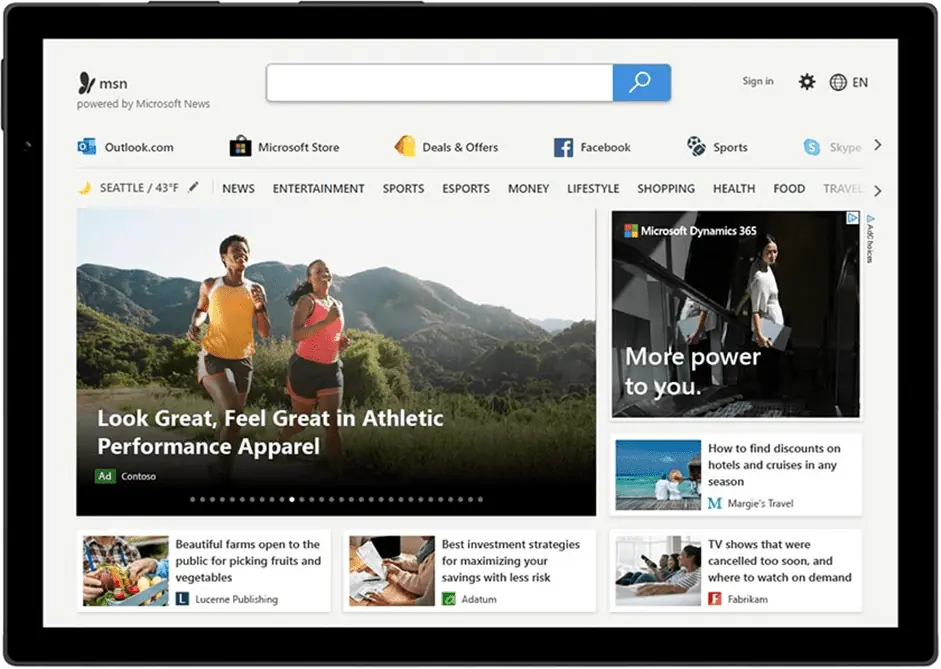
MSN.com today is a refined content portal: news, finance, weather, entertainment, powered by partnerships with global newsrooms and personalized dashboards reflecting Microsoft’s cloud-first strategy.
Key Features of MSN com
News & Content Curation
MSN brings together thousands of sources: global partners like Reuters, The Washington Post, and local outlets catering to over 50 regional editions.
AI-powered personalization tailors the homepage with breaking news, weather widgets, stock trackers, and favorite topics once a Microsoft account is connected.
Seamless Microsoft Ecosystem Integration
Bing search built into every page, driving both regular queries and discovery of breaking stories.
Microsoft 365/Outlook.com login allows custom dashboards; syncs weather, email, cloud storage, and calendar through a “single sign-in” strategy.
The site is tightly linked to Microsoft Start (mobile app), which mirrors the MSN experience on smartphones.
Visual & Interactive Upgrades
High-impact imagery, video news segments, and interactive weather/finance widgets attract a broad casual audience.
Shopping, deals, and e-commerce integrations are powered by Microsoft’s ad network and search intelligence.
Accessibility & Cross-Platform Reach
MSN.com is pre-set as the default homepage on millions of Microsoft Edge browsers worldwide.
Optimized mobile version and dedicated Microsoft Start mobile app.
Available in more than 50 languages and localized to regional content.
MSN.com User Statistics and Audience (2025)
Global Traffic Rank: #64 (all sites), #41 for news/media publishers in the US.
Total Visits: 1.45 billion monthly (August 2025), with growth of 2.75% compared to July.
Pages per Visit: 3.47–5.17 (varies by report).
Average Visit Duration: 6:13 to 17:09 minutes (varies).
Bounce Rate: Approximately 45%.
Audience Gender: 56% male, 44% female.
Largest age group: 45–54 years.
Top countries: United States (21–32%), Germany (5%), South Korea (5%), Brazil (5%), India (4%).
Core audience interests: News, shopping, online sports, adult content, technology, and gaming.
MSN.com Audience Comparison Table (August 2025)
| Metric | MSN.com | Yahoo.com | CNN.com | Foxnews.com |
|---|---|---|---|---|
| Monthly Visits | 1.45B | 546.9M | 416.9M | 249.5M |
| Avg. Visit Time | 17:09 | ~6:13 | — | — |
| Pages per Visit | 3.47–5.17 | — | — | — |
| Top US Share | 21–32% | — | — | — |
Technical Milestones & Microsoft Platform Updates
MSN.com and Microsoft’s New AI Era
Copilot AI Assistance: Integrates document summaries, intelligent news recommendations, and proactive notifications.
Visual Intelligence: Copilot answers questions about MSN.com’s visual news/photo content, supporting accessibility.
PDF Compression & Sharing: Through OneDrive and Edge, users can compress and share files directly from content feeds.
2025 Microsoft 365 and Outlook Improvements
Unified inbox and calendar feedback, with cross-platform account support.
Streamlined file sharing and PDF management via OneDrive.
Enhanced Teams collaboration and notifications integrated with MSN’s web experience.
MSN Messenger & Legacy Services – Impact and End of Era
MSN Messenger (1999–2013) was the precursor to today’s chat apps—file sharing, emoticons, audio/video calls, and status updates became industry standard.
Hotmail (now Outlook.com) began as a key part of MSN, transforming into a leading global webmail solution.
MSN Spaces (blogging) and SkyDrive (now OneDrive) were trialed via the MSN hub before their features migrated to their own dedicated Microsoft services.
Closure of legacy MSN content in 2013 reflected Microsoft’s shift towards cloud apps and streamlined digital products.
MSN.com’s Relevance, Reputation, and Challenges in 2025
Despite the rise of social networks and app-based news portals, MSN retains popularity due to trusted curation, neutral aggregation, and low clickbait exposure.
Integrated with the trusted Microsoft ecosystem (Bing, Outlook, OneDrive, Edge, Copilot).
Attracts an older, affluent demographic, many of whom are power users of Microsoft platforms.
Competition: Google News and Yahoo News for search+news, CNN and NYT for direct journalism, but MSN’s unique value lies in its aggregation and Microsoft product tie-ins.
The Future of MSN.com
Deeper Copilot/AI-driven personalization—more adaptive dashboards, voice-guided news curation, and predictive alerting.
Possible expansion into audio summaries for news stories and richer video content experiences.
Greater localization as Microsoft targets emerging markets (India, Brazil, Southeast Asia), and integrates more non-English sources.
Ongoing platform security enhancements aligned with Microsoft 365’s focus on privacy and accessibility.
FAQs: MSN.com
1. What is MSN.com’s relationship to Microsoft?
MSN.com is Microsoft’s official news and lifestyle portal, deeply integrated with Bing, Edge, Outlook, and Microsoft 365 services.
2. How popular is MSN.com in 2025?
It receives over 1.45B monthly visits, ranking among the world’s top 100 websites and top 50 news/media publishers.
3. Is MSN.com still the default homepage on Microsoft Edge?
Yes, MSN.com remains the pre-set homepage for millions of Edge browser users and is closely tied to Microsoft Start on mobile.
4. Can MSN be personalized?
Yes. Users with a Microsoft account can customize news, weather, finance, and sports feeds. Preferences sync across devices.
5. Did MSN Messenger become Skype?
Yes. MSN Messenger was discontinued in 2013, with Skype becoming Microsoft’s default messaging platform thereafter.
6. Does MSN.com have its own journalists?
No. MSN.com primarily aggregates licensed and syndicated content from major news providers, using AI for curation.
7. Is MSN.com accessible worldwide?
Yes, it serves 50+ countries, is localized in dozens of languages, and has significant audiences in the US, EU, Asia, and Latin America.
8. What are the latest upgrades in 2025?
AI-powered Copilot and Microsoft 365 integrations bring smarter recommendations, improved productivity, and seamless file handling.
9. How does MSN.com make money?
Primarily through advertising revenue—banner ads, native ads, sponsored content, and integrated commerce.
10. Is MSN.com free to use?
Yes. MSN.com is free and open to all users; some deeper personalization requires Microsoft account sign-in.