






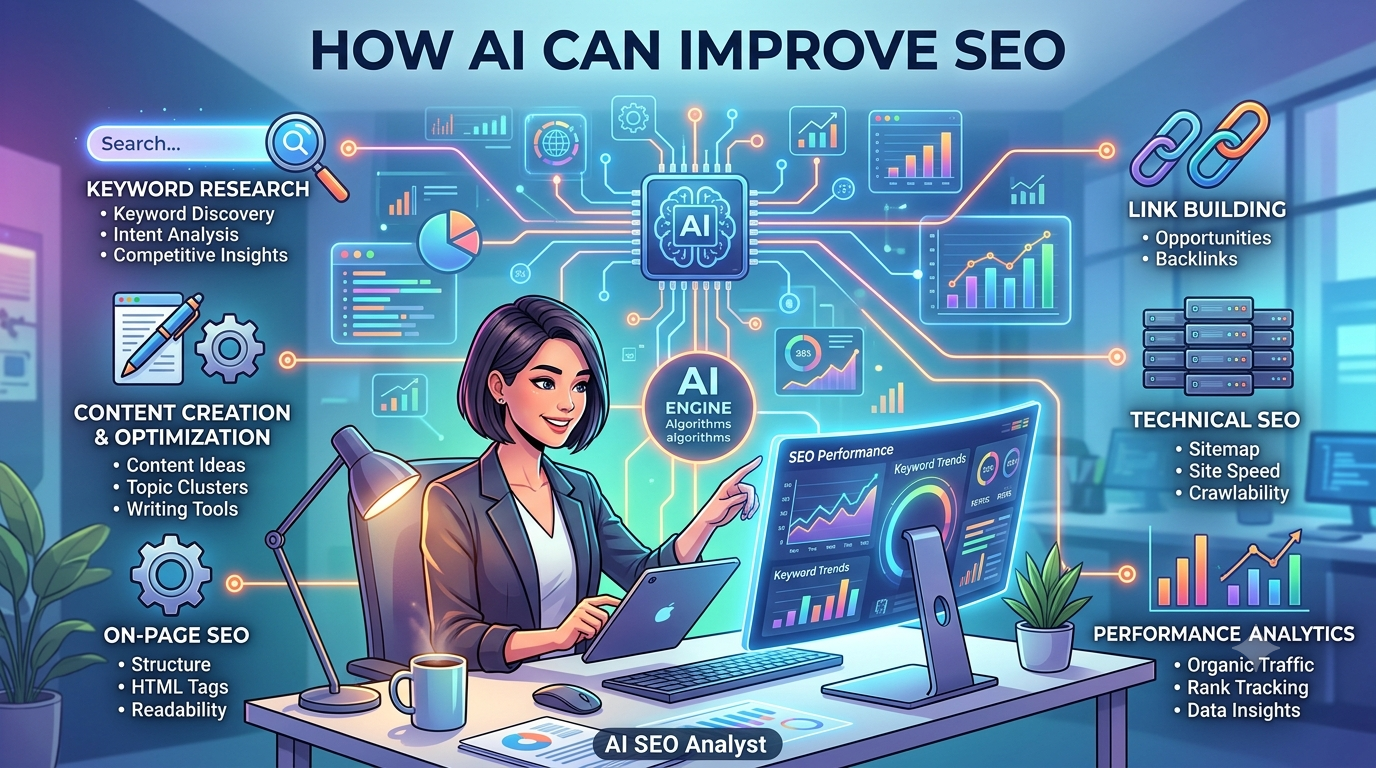
Search engine optimization has never stood still, but the pace of change over the last few years has been unlike anything the industry has seen before. Search engines now use machine learning to interpret intent rather than just matching keywords. Search results pages increasingly feature AI-generated summaries instead of ten blue links. And the tools marketers use to research, write, and optimize content are themselves powered by artificial intelligence.
This shift raises an obvious question for anyone responsible for organic visibility: how exactly does AI in SEO work, and how can it be used to get better results? This guide walks through the practical ways AI is reshaping every stage of the SEO process — from keyword research and content creation to technical audits, link building, and local search — along with the risks to watch for and a step-by-step framework for building an AI-powered SEO strategy.
Table of Contents
What Is AI-Driven SEO?
AI-driven SEO refers to the use of machine learning, natural language processing (NLP), and predictive analytics to plan, create, and optimize content and websites for search engines. Rather than relying purely on manual keyword spreadsheets and gut instinct, AI-driven SEO uses data models to identify patterns humans would take far longer to find — search intent clusters, content gaps, technical issues, and ranking opportunities.
It’s worth separating two related but distinct ideas:
- AI used by search engines themselves. Google’s ranking systems incorporate machine learning models (such as RankBrain and the broader systems that power features like AI Overviews) to better understand queries, context, and relevance. Understanding how these systems interpret content is now part of doing SEO well.
- AI used by SEO practitioners. This includes AI-powered tools and workflows used by marketers and content teams — for research, writing, technical analysis, and reporting — to do the work of SEO faster and more accurately.
Both matter. Optimizing for the first means SEO professionals need to write more naturally, address topics comprehensively, and demonstrate expertise. Adopting the second means SEO teams can move faster, test more ideas, and base decisions on more data than they could realistically process by hand.
Why AI Matters More for SEO Now Than Ever
A few converging trends explain why this topic deserves attention right now:
- Search results increasingly include AI-generated answers. Features like Google’s AI Overviews summarize information directly on the results page, changing how and whether users click through to a website.
- Search intent is harder to fake. Algorithms are better at recognizing thin, keyword-stuffed, or low-effort content, which makes genuine topical depth more valuable.
- The volume of content competing for attention has exploded. AI tools make it easier to publish more content, which means differentiation and quality matter more, not less.
- User behavior is shifting toward conversational and voice queries. People increasingly phrase searches as full questions, and AI systems are better equipped to match that phrasing to relevant content.
Together, these trends mean that ignoring AI — either as a ranking factor or as a productivity tool — puts a website at a real disadvantage.
How AI Is Changing Keyword Research
Keyword research used to mean pulling a list of search terms, sorting by volume, and picking the ones with the best ratio of traffic to competition. AI has expanded what’s possible in several important ways.
Smarter Intent Clustering
Traditional keyword tools return long lists of similar-looking phrases without much context about how they relate to each other. AI-powered keyword tools can now group thousands of keywords into intent-based clusters — separating, for example, “best running shoes for flat feet” (commercial investigation) from “how to choose running shoes” (informational) from “buy running shoes online” (transactional). This clustering helps content teams build pages that actually match what searchers want, rather than guessing based on volume alone.
Predictive Search Volume and Trend Forecasting
Machine learning models can analyze historical search patterns alongside external signals — seasonality, news cycles, social trends — to forecast which topics are likely to grow in search interest before they peak. This gives content teams a head start on topics before competitors catch on, rather than reacting after a trend has already become saturated.
Semantic and Topic-Based Research
Because modern search engines understand meaning rather than just matching exact words, keyword research has shifted toward topic modeling. AI tools can analyze a page or a niche and surface the full universe of related subtopics, questions, and entities that should be covered to be considered comprehensive on a subject — not just the head keyword, but the long tail of related queries a thorough article should answer.
Competitive Gap Analysis at Scale
AI can compare a website’s existing content against dozens or hundreds of competitor pages simultaneously, identifying which subtopics competitors cover that a site is missing. This used to require hours of manual content audits; AI tools can do the comparison in minutes and flag the highest-opportunity gaps based on estimated traffic potential and competition level.
Practical Takeaway
The real shift here isn’t that AI replaces keyword research — it’s that AI changes the unit of analysis from individual keywords to topics and intents. Teams that build content around comprehensive topic coverage, informed by AI-driven clustering, tend to outperform teams still working from flat keyword lists.
AI-Powered Content Creation and Optimization
Content is where AI’s impact on SEO is most visible — and most debated. Used well, AI can dramatically speed up research, drafting, and optimization. Used poorly, it can flood a site with generic, low-value pages that hurt rankings rather than help them.
Research and Outlining
Before a single word of a draft is written, AI tools can summarize what top-ranking pages cover, extract common subheadings and structures, and suggest an outline that addresses the topic more completely than any single competitor. This doesn’t mean copying competitors — it means understanding what searchers expect to find on the topic so nothing important is missed.
Drafting Assistance
AI writing tools can generate first drafts, suggest phrasing, and help overcome the blank-page problem, especially for repetitive content types like product descriptions, FAQ pages, or location pages. The most effective teams use AI drafts as a starting point, then add original insight, data, examples, and a distinct point of view — the elements that differentiate genuinely useful content from generic filler.
On-Page Optimization
AI-powered optimization tools can analyze a draft against top-ranking pages for a target topic and suggest:
- Related terms and entities that should appear in the content
- Ideal content length ranges based on what’s currently ranking
- Header structure improvements
- Internal linking opportunities
- Readability adjustments for the target audience
This kind of real-time, data-informed editing used to require manually reviewing multiple competing pages. AI tools compress that process into a few minutes.
Content Refreshing and Decay Detection
Pages lose rankings over time as competitors publish newer content and search intent evolves. AI tools can monitor a site’s existing content, detect which pages are losing visibility or traffic, and prioritize a refresh schedule based on which updates are likely to have the biggest impact — rather than refreshing content randomly or reactively.
Personalization at Scale
For larger sites, AI can help tailor content variations for different audience segments, regions, or use cases without requiring a writer to manually produce dozens of near-identical pages. This is particularly useful for e-commerce category pages, local service pages, and multi-market content strategies.
The Quality Question
Search engines have been explicit that content quality, not the method of production, determines how content is evaluated. Thin, repetitive, or unhelpful content generated purely by AI without editorial oversight tends to underperform — and can attract scrutiny from algorithm updates aimed at low-value content. The practical lesson: AI is best treated as a co-writer and research assistant, not an autopilot. Human review, original insight, fact-checking, and a clear point of view remain essential to content that actually earns rankings and trust.
AI in Technical SEO
Technical SEO is one of the areas where AI delivers some of the most immediate, measurable value — largely because technical issues are pattern-based and data-heavy, which is exactly what machine learning is good at detecting.
Automated Site Audits
AI-enhanced crawling tools can scan a site and automatically prioritize issues by estimated impact rather than just listing every error equally. Instead of a flat list of broken links, duplicate titles, and missing alt text, AI-driven audit tools can rank issues by how much they’re likely to be holding back visibility, helping teams focus on fixes that matter most first.
Anomaly Detection in Performance Data
AI models can continuously monitor crawl stats, indexation data, Core Web Vitals, and traffic patterns to spot anomalies — like a sudden drop in indexed pages or an unexpected spike in crawl errors — often before a human would notice the pattern in a dashboard. Early detection means problems get fixed before they cause significant ranking damage.
Log File Analysis
Server log files contain a record of exactly how search engine crawlers interact with a site, but they’re often too large and unstructured for manual review. AI tools can process millions of log lines to reveal crawl budget waste, identify pages crawlers are ignoring, and highlight sections of a site that need better internal linking to get discovered.
Structured Data and Schema Suggestions
AI tools can analyze a page’s content and recommend the most relevant schema markup to apply, helping search engines understand entities, relationships, and content type more precisely — which can improve eligibility for rich results.
Predicting the Impact of Technical Fixes
Some advanced AI-driven platforms can model the likely traffic or ranking impact of a proposed technical change before it’s implemented, based on patterns observed across large datasets of similar sites. This helps technical teams prioritize their backlog by expected return rather than guesswork.
Site Architecture and Internal Linking
AI can analyze a site’s full link graph and suggest internal linking improvements — identifying orphaned pages, pages with too few internal links pointing to them relative to their importance, and opportunities to pass authority more effectively between related pages.
AI for Search Intent, SERP, and Competitor Analysis
Understanding what’s actually working for competitors — and why — used to require manually reviewing search results page by page. AI has made this kind of analysis both faster and deeper.
SERP Feature Tracking
AI-powered rank tracking tools don’t just record position; they can classify which SERP features appear for a query (featured snippets, “People Also Ask” boxes, image packs, video carousels, AI Overviews) and flag which ones a site is eligible to target. This helps teams decide where to invest optimization effort for the highest-visibility features, not just the standard organic listing.
Competitor Content Pattern Recognition
By analyzing large numbers of top-ranking pages across a niche, AI tools can detect patterns that correlate with strong rankings — content length ranges, the presence of certain media types, structural choices like comparison tables or FAQ sections, and common entities mentioned. These patterns aren’t guarantees of ranking success, but they offer a useful, data-informed starting point.
Sentiment and Brand Perception Monitoring
AI-driven tools can scan reviews, social mentions, and forum discussions to gauge how a brand is perceived, which increasingly matters for SEO as search engines weight signals related to trustworthiness and reputation, especially for topics that affect people’s health, finances, or safety.
Predicting Algorithm Update Impact
Some platforms use machine learning to analyze ranking volatility across many sites following a known algorithm update, helping identify what kinds of pages were affected and why. This kind of pattern analysis can help teams understand whether a traffic drop is part of a broader trend or specific to their own site.
AI and the Changing Search Landscape: AI Overviews, Voice, and Conversational Search
Perhaps the most significant way AI is reshaping SEO isn’t about the tools marketers use — it’s about how search engines themselves are changing the experience of searching.
AI Overviews and Answer Engines
Search engines now generate AI-written summaries directly on the results page for many queries, pulling from multiple sources to answer a question without requiring a click-through. This has real implications for SEO strategy:
- Being the cited source matters more. Even when a user doesn’t click through, being referenced as a source in an AI-generated summary can build brand visibility and trust.
- Clear, well-structured answers are favored. Content that directly and concisely answers a specific question — ideally near the top of a page — is more likely to be pulled into AI-generated summaries.
- Depth still matters for the click. Once a basic question is answered by an AI summary, the content that earns the click is the content that goes further: original analysis, data, examples, or context the summary couldn’t capture.
Voice Search Optimization
Voice queries tend to be longer, more conversational, and phrased as full questions (“what’s the best way to remove a wine stain from a carpet”) rather than short keyword phrases (“wine stain removal”). Optimizing for voice search means:
- Writing in a natural, conversational tone that mirrors how people actually speak
- Directly answering common questions early in the content, ideally in a concise sentence or two that could be read aloud
- Using FAQ-style sections that map closely to how people phrase spoken queries
- Prioritizing featured snippet optimization, since many voice assistants pull answers from snippet-eligible content
Conversational and Multi-Turn Search
As AI-powered search and chat interfaces become more common, users increasingly engage in multi-turn conversations rather than single queries — asking a follow-up question based on a previous answer. This rewards content that’s structured around a topic’s full context rather than a single narrow keyword, since a comprehensive resource is more likely to satisfy the range of follow-up questions a conversational system might generate.
Answer Engine Optimization (AEO)
A newer discipline sometimes called “answer engine optimization” focuses specifically on making content easy for AI systems to extract, summarize, and cite accurately. Practical tactics include:
- Using clear, descriptive headers that match natural-language questions
- Placing direct, quotable answers near the top of a section
- Using structured data to make facts machine-readable
- Maintaining accuracy and citing credible sources, since AI systems favor content that demonstrates expertise and trustworthiness
AI for Link Building and Outreach
Link building has always been one of the more manual, relationship-driven parts of SEO. AI hasn’t replaced the relationship element, but it has made the supporting research and logistics significantly more efficient.
Prospect Identification
AI tools can analyze a site’s backlink profile and a competitor’s backlink profile simultaneously, surfacing realistic link prospects based on topical relevance, domain authority, and existing relationship signals — rather than relying on generic outreach lists.
Personalized Outreach at Scale
Natural language generation can help draft personalized outreach emails that reference a prospect’s specific content, audience, or recent work, making outreach feel less like a mass campaign — provided a human still reviews and refines each message before sending. Outreach that’s obviously generic or AI-generated without personalization tends to underperform and can damage a brand’s reputation with publishers.
Link Quality Assessment
AI models can evaluate the likely value and risk of a potential link by analyzing a referring site’s traffic patterns, content quality, link profile, and historical behavior — helping teams avoid low-quality or spammy link sources that could create risk rather than benefit.
Content Gap-Driven Linkable Asset Ideas
By analyzing what kind of content tends to attract links in a given niche — original research, data studies, interactive tools, comprehensive guides — AI can help identify what type of “linkable asset” a site should invest in creating to attract earned links naturally.
AI for Local SEO
Local search has its own dynamics, and AI is improving how businesses manage visibility across multiple locations.
Review Analysis and Response
AI tools can analyze large volumes of customer reviews to identify recurring themes, sentiment trends, and operational issues, and can draft personalized responses to reviews at scale — both of which influence local ranking signals and customer trust.
Local Listing Consistency
For businesses with many locations, AI-powered tools can monitor business listings across directories, flag inconsistencies in name, address, and phone number data (a known local ranking factor), and help standardize information automatically.
Localized Content Generation
AI can help generate location-specific page variations — adapting core service content to reflect local landmarks, regional terminology, or location-specific details — while still requiring human review to ensure each page offers genuine local value rather than being a thin, templated duplicate.
Predicting Local Demand Patterns
Machine learning models can analyze seasonal and geographic search trends to help local businesses anticipate demand spikes and adjust content, promotions, or service area pages proactively.
AI for E-Commerce SEO
E-commerce sites face a unique SEO challenge: thousands of product pages, category pages, and variations that all need to be discoverable, unique, and optimized — at a scale that makes manual optimization impractical. AI has become particularly valuable in this context.
Automated Product Description Generation
Rather than leaving product pages with thin, manufacturer-supplied descriptions (which often appear duplicated across many competing retailers), AI tools can generate unique, optimized descriptions for each product variant at scale, incorporating relevant attributes, use cases, and search terms that real shoppers use.
Category and Faceted Navigation Optimization
Large catalogs often generate enormous numbers of filtered and faceted URLs (by size, color, price range, and so on), which can create duplicate content and crawl budget problems if left unmanaged. AI-driven crawling tools can identify which faceted combinations have genuine search demand worth indexing and which should be excluded or consolidated, helping search engines focus on the pages that matter.
Dynamic Internal Linking for Product Discovery
AI recommendation engines — similar to the “customers also bought” systems used for merchandising — can be applied to internal linking strategy, surfacing related products and category pages in a way that distributes link equity intelligently across a catalog rather than concentrating it on a handful of bestsellers.
Demand Forecasting for Seasonal Content
Machine learning models can analyze historical sales and search trends to predict upcoming demand spikes — holiday shopping periods, seasonal products, trending categories — giving e-commerce SEO teams time to optimize and publish relevant pages before demand peaks rather than reacting after the opportunity has passed.
Best Types of AI Tools for SEO
Rather than recommending specific products — which change and evolve constantly — it’s more useful to understand the categories of AI-powered SEO tools available, since most SEO teams will use a combination of several:
- AI content optimization platforms that analyze drafts against top-ranking competitors and suggest improvements to structure, terms, and depth.
- AI writing assistants that help with research, outlining, and drafting.
- All-in-one SEO suites that have integrated AI features into existing keyword research, rank tracking, and site audit tools.
- Technical SEO crawlers with AI-driven issue prioritization and anomaly detection.
- AI-powered analytics platforms that surface insights and anomalies from traffic and search performance data automatically.
- Backlink analysis tools with AI-driven prospect scoring and risk assessment.
- Rank tracking tools that classify SERP features and AI Overview appearances.
When evaluating any AI SEO tool, it’s worth checking current reviews and product documentation directly, since this is a fast-moving space where capabilities and pricing change frequently.
Risks, Limitations, and Ethical Considerations of AI in SEO
AI offers real advantages in SEO, but it isn’t a guaranteed shortcut, and using it carelessly can create real problems.
Generic, Low-Differentiation Content
The biggest risk of AI-assisted content is sameness. When many sites use similar AI tools with similar prompts, the resulting content can converge toward generic, interchangeable text that doesn’t stand out — and doesn’t earn the kind of engagement, links, or shares that build long-term authority.
Accuracy and Hallucination Risk
AI language models can generate plausible-sounding but factually incorrect information. Publishing AI-generated claims, statistics, or quotes without independent verification creates real risk, especially on topics where accuracy matters for user safety or trust (health, finance, legal topics).
Over-Reliance on Automation for E-E-A-T
Search engines increasingly emphasize experience, expertise, authoritativeness, and trustworthiness as quality signals — concepts that are inherently human. Content with no real human experience or expertise behind it, even if well-optimized, tends to lack the depth and credibility that actually performs well over time.
Algorithmic Detection of Low-Value Content
Search engines have explicitly stated that they target low-quality, unhelpful content regardless of how it was produced, including content created primarily to manipulate rankings rather than serve users. Mass-producing AI content without editorial oversight is a documented path to ranking problems, not a reliable growth shortcut.
Data Privacy and Tool Transparency
Many AI SEO tools process proprietary business data, customer reviews, or analytics. It’s worth understanding how a given tool handles and stores that data, particularly for businesses in regulated industries.
The Human Judgment Gap
AI tools are excellent at pattern recognition across large datasets, but they don’t inherently understand a brand’s voice, strategic priorities, or audience nuance the way a human strategist does. The most effective approach treats AI as a powerful assistant that informs human decision-making, not a replacement for it.
How to Build an AI-Powered SEO Strategy: A Step-by-Step Framework
Bringing all of this together, here’s a practical framework for integrating AI into an SEO strategy without falling into the common pitfalls.
Step 1: Audit Your Current SEO Foundation
Before adding AI tools, get a clear picture of where the site stands — current rankings, technical health, content performance, and backlink profile. AI tools are most valuable when applied to a clear baseline, not as a substitute for understanding the fundamentals.
Step 2: Use AI for Research, Not Final Decisions
Apply AI to the research-heavy stages: keyword clustering, competitor gap analysis, technical audits, and content briefs. Use the output to inform decisions, but have a human strategist review and prioritize based on business goals, not just raw data output.
Step 3: Draft with AI, Edit with Expertise
Let AI assist with first drafts and structural suggestions, but ensure every piece of content gets meaningful human input — original examples, real expertise, updated data, and a distinct perspective that a generic AI draft wouldn’t include on its own.
Step 4: Automate Monitoring, Not Judgment
Use AI-powered monitoring for technical issues, ranking changes, and content decay — these are pattern-detection tasks AI handles well. Keep judgment calls about strategy, messaging, and prioritization with human decision-makers.
Step 5: Optimize for Both Traditional Rankings and AI Overviews
Structure content to perform well in traditional organic results and to be easily extracted and cited by AI-generated summaries — clear answers, strong structure, credible sourcing, and genuine depth beyond the basic answer.
Step 6: Build Genuine Authority Signals
Invest in the things AI can’t fabricate convincingly: real case studies, original research, demonstrable experience, and a recognizable point of view. These remain the most durable differentiators as more competitors adopt similar AI tools.
Step 7: Measure, Learn, and Iterate
Track not just rankings and traffic, but also visibility in AI Overviews and answer engines, citation frequency, and engagement metrics that indicate content is genuinely satisfying user intent — not just technically optimized.
Measuring the ROI of AI in SEO
Adopting AI tools involves real costs — subscription fees, training time, and the effort of integrating new workflows into existing processes. Before scaling up AI usage across a team, it’s worth measuring whether it’s actually paying off.
Time Saved vs. Output Quality
The most immediate and measurable benefit of AI in SEO is usually time savings: research that took hours now takes minutes, audits that took days now take an afternoon. But time saved only translates into business value if the output quality holds up. Track not just speed, but whether AI-assisted content and analysis lead to comparable or better rankings, traffic, and engagement than the previous manual process.
Content Performance Benchmarking
For teams using AI to assist with content creation, it’s useful to benchmark AI-assisted content against historical, fully human-written content on the same site — comparing rankings achieved, time to rank, organic traffic, and engagement metrics like time on page and conversion rate. This helps identify whether AI assistance is genuinely improving outcomes or simply increasing publishing volume without a corresponding lift in results.
Cost Per Ranking Improvement
For technical and link-building applications, it can help to track the cost of AI tools against the tangible outcomes they enable — number of technical issues resolved, qualified link prospects identified, or keyword rankings improved — to understand whether the tool is delivering a worthwhile return relative to its cost.
Avoiding Vanity Metrics
It’s easy to measure AI’s impact in terms of output volume — number of articles published, number of audits run, number of outreach emails sent — but these are vanity metrics if they don’t translate into actual visibility, traffic, or revenue. The more meaningful question is whether AI adoption is improving the metrics that matter to the business: organic traffic growth, qualified leads, conversions, and revenue attributable to organic search.
Looking ahead, a few trends seem likely to continue shaping how AI and SEO intersect:
- Search will keep moving toward answer-first experiences, making structure, clarity, and citability increasingly important alongside traditional ranking factors.
- AI tools will become more deeply integrated into everyday SEO workflows, reducing the time spent on repetitive research and audit tasks and shifting human effort toward strategy, creativity, and quality control.
- Differentiation will increasingly come from things AI can’t replicate — original data, genuine experience, distinctive brand voice, and trust built over time.
- Search engines will continue refining their ability to detect low-value, AI-generated content at scale, reinforcing that quality and usefulness remain the foundation of sustainable rankings, regardless of how content is produced.
The practical implication is straightforward: businesses that use AI to work faster and smarter — while still investing in genuine expertise and originality — are likely to be the ones that benefit most. Those that use AI purely to mass-produce generic content are likely to find diminishing returns as search engines and AI Overviews get better at separating genuinely useful content from filler.
Conclusion
AI is no longer an optional add-on to SEO — it’s becoming part of the infrastructure of search itself, from how engines interpret queries to how marketers research, write, and optimize content. The opportunity is significant: faster research, smarter content decisions, more efficient technical audits, and better-informed link building. But the fundamentals haven’t changed. Search engines still reward content that genuinely helps people, demonstrates real expertise, and earns trust over time.
The most effective approach isn’t choosing between AI and human expertise — it’s combining them. Let AI handle the data-heavy, repetitive work it’s good at, and keep human judgment, creativity, and genuine experience at the center of the strategy. That combination is what will separate sites that thrive in an AI-influenced search landscape from those that simply add noise to it.
FAQs
Q1. Does using AI to write content hurt SEO rankings?
Not inherently. Search engines have stated that they evaluate content based on quality and helpfulness, not the method used to produce it. Low-quality, unedited AI content tends to underperform, but well-researched, human-reviewed content that happens to be AI-assisted can perform just as well as fully human-written content.
Q2. Can AI replace an SEO strategist?
AI can handle research, pattern detection, and repetitive analysis far faster than a human, but it doesn’t replace strategic judgment, brand understanding, or the original expertise that makes content genuinely valuable. The most effective setups combine AI efficiency with human strategy.
Q3. How does AI affect keyword research?
AI improves keyword research by clustering keywords into intent-based topics, forecasting emerging trends, and identifying content gaps relative to competitors — shifting the focus from isolated keywords to comprehensive topic coverage.
Q4. What is Answer Engine Optimization (AEO)?
AEO is the practice of structuring content so it’s easily extracted, summarized, and cited by AI-generated answers and AI Overviews — using clear headers, direct answers, and credible sourcing.
Q5. Is it risky to rely too heavily on AI for SEO?
Yes, if AI is used to mass-produce generic content without human oversight, fact-checking, or genuine expertise. The risk isn’t AI itself, but using it as a substitute for quality control and original insight rather than as a research and drafting assistant.
Q6. How is AI changing technical SEO audits?
AI-enhanced audit tools can prioritize technical issues by estimated business impact rather than listing every error with equal weight, detect performance anomalies before they show up in standard reporting, and analyze server log files at a scale that would be impractical to review manually.
Q7. Will AI Overviews reduce organic traffic for good content?
AI-generated summaries can reduce clicks for simple, single-fact queries that are fully answered within the summary itself. However, content that goes beyond the basic answer — offering original analysis, deeper context, or practical detail a summary can’t capture — continues to earn clicks from users who want more than a quick answer. The strategic response is to ensure content adds clear value beyond what an AI summary alone could provide.