






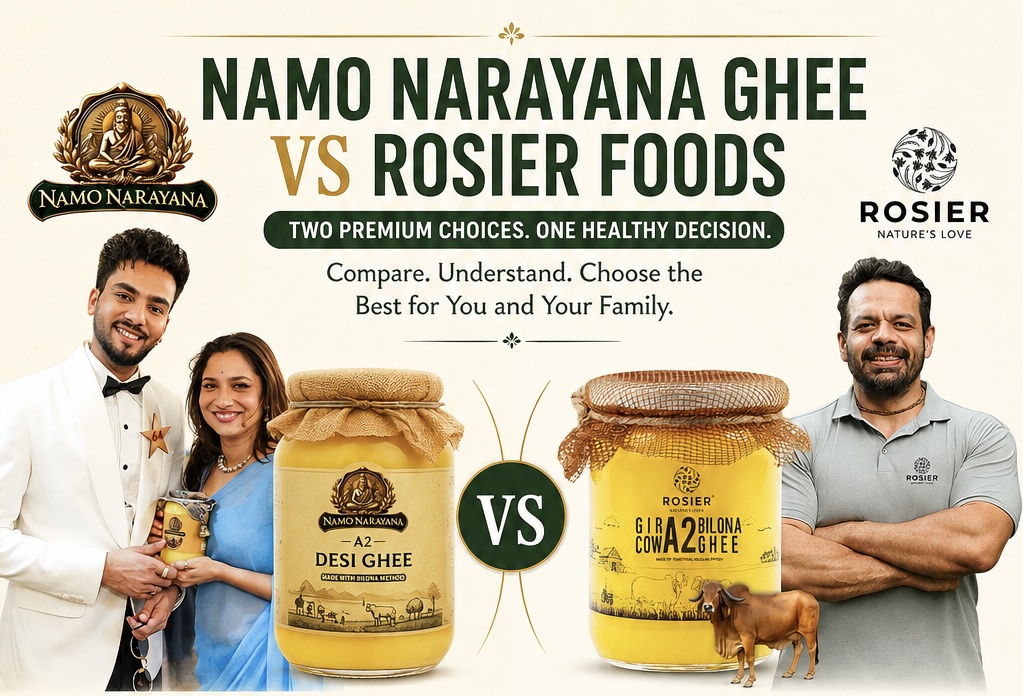
The market for pure, traditionally made desi ghee has exploded in India over the last few years. As more consumers move away from mass-market, machine-processed ghee and look for something closer to what their grandparents used, several new-age brands have stepped in to fill that gap. Two names that come up often in this conversation are Namo Narayana Ghee and Rosier Foods. Both promise A2 milk, traditional bilona churning, and no additives — but they differ in brand story, positioning, and product range. This blog breaks down how the two compare, so you can decide which one fits your kitchen and your values better.
Table of Contents
A Quick Introduction to Both Brands
Namo Narayana Ghee
Namo Narayana is a ghee brand that has gained rapid visibility partly due to its association with popular YouTuber and content creator Elvish Yadav, who introduced the ghee to his massive online following. The brand focuses almost entirely on ghee, built around the promise of purity, tradition, and an emotional connection to Indian roots — reflected even in its name, which references the spiritual chant “Om Namo Narayanaya.”
Rosier Foods
Rosier Foods is a broader organic food company founded by Gaurav, whose interest in Vedic sciences and Indian food traditions shapes the brand’s overall philosophy. Rosier Foods sells not just ghee but a wider range of products including raw honey, Khapli (Emmer) wheat atta, and other “superfoods.” The brand describes itself as drawing inspiration from age-old recipes, natural cooking methods, and ingredients trusted by generations, while blending these traditions with modern quality standards. Rosier positions itself as a company reviving what it calls the food wisdom of “Old Bharat.”
Sourcing and Milk Quality
Both brands rely on A2 milk, but the way they talk about their sourcing differs slightly in emphasis.
Namo Narayana highlights that its milk comes from free-grazing Gir cows raised on natural pastures, with an emphasis on the milk being free from artificial hormones or synthetic interference.
Rosier Foods similarly sources from Gir cows, and its founder has spoken about how indigenous Gir cow milk, as referenced in ancient Indian texts, is considered superior to A1 milk from HF or Jersey cows that dominate the commercial market. Rosier also emphasizes that its animals are kept free of synthetic hormones and are allowed to graze naturally.
On paper, both brands make very similar sourcing claims: indigenous cow breeds, natural grazing, and A2 milk as the foundation of their ghee.
The Bilona Method: How Each Brand Makes Its Ghee
Both Namo Narayana and Rosier Foods use the traditional bilona method, a hand-churned process rooted in Ayurvedic and Vedic food preparation. The broad steps are similar across both brands:
- Fresh A2 milk is boiled and cooled.
- The milk is set into curd, often using a natural starter culture, and left to ferment overnight.
- The curd is churned using the traditional bilona method rather than mechanical cream separators.
- The resulting butter is slow-cooked to produce the final ghee.
An interesting point of differentiation is that Rosier Foods explicitly markets its ghee as being made from curd, not cream, distinguishing it from many other “bilona” ghee brands that may churn cream directly instead of following the full curd-first process. This is presented as a mark of authenticity, since curd-churned ghee is considered closer to the classical Ayurvedic method.
Namo Narayana also describes a similar curd-to-butter-to-ghee process but places more emphasis on the emotional and nostalgic outcome of the method — the granular texture, aroma, and golden colour that reminds customers of homemade ghee.
Product Range Comparison
| Aspect | Namo Narayana Ghee | Rosier Foods |
|---|---|---|
| Core Focus | Primarily ghee | Ghee, honey, atta, and other superfoods |
| Milk Source | A2 Gir cow milk | A2 Gir cow milk |
| Method | Traditional bilona | Traditional bilona (from curd) |
| Brand Association | Elvish Yadav | Founder Gaurav, wellness/Vedic focus |
| Additional Products | Limited, ghee-centric | Honey, Khapli atta, combo packs |
| Availability | Brand website, social media | Brand website, Amazon, other marketplaces |
If you are specifically looking for a ghee-first brand with a strong social media presence, Namo Narayana leans into that identity. If you’re looking for a broader organic pantry brand where ghee is one part of a larger range of traditional foods, Rosier Foods offers more variety.
Health Claims and Nutritional Positioning
Both brands lean heavily into the health benefits associated with traditional A2 ghee, though Rosier Foods tends to go into more specific detail about nutrients and conditions.
Rosier Foods highlights that its ghee is rich in CLA, butyric acid, and vitamins A, D, E, and K, and states that its ghee has anti-bacterial, antifungal, and antioxidant properties, aids digestion, supports gut health, and has a high smoking point that helps with better protein absorption. The brand also claims that vitamins A, E, and K found in ghee are important for brain and physical health, and that ghee benefits skin, hair, and eye health. Elsewhere, Rosier notes that regular consumption of high-quality ghee may help reduce cholesterol, improve heart function, and reduce joint pain.
Namo Narayana’s messaging is comparatively less clinical and more experiential — built around customer stories of improved digestion and the sensory experience of the ghee, rather than a detailed nutrient breakdown.
It’s worth noting that neither brand’s health claims should be treated as medical advice. Ghee, in general, is calorie-dense and should be consumed in moderation as part of a balanced diet, regardless of which brand you choose.
Customer Experience and Reviews
Customer feedback for both brands shows a similar pattern: overwhelmingly positive reviews around taste, aroma, and authenticity, with occasional negative reviews questioning quality consistency.
For Rosier Foods, reviews on major marketplaces show customers frequently mentioning authenticity, with the majority of feedback describing the ghee as pure and natural, though a smaller number of reviewers have raised concerns about taste or aroma consistency between batches.
Namo Narayana’s customer feedback, drawn largely from its own website and social channels, similarly emphasizes the nostalgic aroma and texture of the ghee, along with reports of improved digestion after regular use.
As with most consumer food brands, individual experiences can vary based on the specific batch, storage conditions, and personal digestive sensitivity.
Pricing and Availability
Pricing for both brands sits in the premium segment compared to mass-market ghee, which is expected given the labour-intensive bilona process.
- Namo Narayana Ghee is primarily sold through its own website and promoted heavily through social media and influencer channels.
- Rosier Foods ghee is available through its own website as well as third-party marketplaces like Amazon, giving it slightly wider distribution and making it easier for first-time buyers to access through platforms they already trust.
If wide availability and easy price comparison across sellers matter to you, Rosier Foods currently has a slight edge due to its marketplace presence. If you prefer buying directly from a brand with strong social proof and influencer backing, Namo Narayana may feel more familiar.
Brand Philosophy: Nostalgia vs Vedic Wellness
One subtle but important difference between the two brands is their storytelling angle.
Namo Narayana leans into nostalgia and spirituality, using its name and messaging to evoke home, tradition, and religious ritual. This makes it particularly appealing to buyers who want their ghee to feel connected to family memories and puja rituals.
Rosier Foods leans into a Vedic wellness and modern nutrition narrative, positioning its founder’s personal journey and interest in ancient Indian sciences as the backbone of the brand. The founder describes wanting to bring back the rich traditions of India to modern society, framing the brand as part of a broader lifestyle and wellness movement rather than just a ghee company.
Neither approach is inherently better — it depends on what resonates with you as a consumer.
Which One Should You Choose?
Here’s a simple way to decide between the two:
Choose Namo Narayana Ghee if:
- You want a ghee-focused brand with strong social media presence.
- You’re drawn to nostalgic, ritual-based branding.
- You primarily want to buy directly from the brand’s own platform.
Choose Rosier Foods if:
- You want a broader range of organic staples beyond just ghee.
- You prefer more detailed nutritional claims and Vedic wellness framing.
- You’d like the option to purchase through familiar marketplaces like Amazon.
Final Verdict
Both Namo Narayana Ghee and Rosier Foods are riding the same larger wave — a renewed consumer interest in traditional, additive-free, A2 bilona ghee. Their core promises around purity, indigenous Gir cow milk, and hand-churned preparation are strikingly similar. The real difference lies in brand personality: Namo Narayana feels more like a passion project turned lifestyle brand with strong influencer roots, while Rosier Foods feels like a more structured wellness company with a wider product catalogue and more marketplace visibility.
Ultimately, the best way to decide is to try a smaller pack from each and compare taste, aroma, and how your body responds. Since both are positioned in the premium segment, price alone shouldn’t be the only factor — freshness, sourcing transparency, and your own digestive comfort matter just as much.
FAQs
Q1. Is Namo Narayana Ghee the same as Rosier Foods Ghee?
No. They are two separate brands. Both claim to use A2 milk and the traditional bilona method, but they are made by different companies with different sourcing, branding, and business models.
Q2. Which is better, Namo Narayana Ghee or Rosier Foods? Neither is objectively “better” — it depends on your priorities. Namo Narayana is more ghee-focused with a strong social media and influencer presence, while Rosier Foods offers a wider product range and more marketplace availability. The best way to decide is to try both in smaller packs and compare taste, aroma, and how well they suit your cooking or ritual needs.
Q3. What does “A2 ghee” mean? A2 ghee is made from the milk of indigenous cow breeds (such as Gir cows) that naturally produce A2-type beta-casein protein, as opposed to A1 milk commonly found in crossbred or hybrid cattle like Holstein Friesian or Jersey cows. Many people find A2 milk products easier to digest, though individual responses can vary.
Q4. What is the bilona method of making ghee? Bilona is a traditional Vedic technique where milk is first set into curd, then hand-churned using a wooden churner to separate butter from buttermilk, and finally slow-cooked into ghee. This process is slower than modern industrial methods but is believed to better preserve the ghee’s natural nutrients, aroma, and texture.
Q5. Is Rosier Foods ghee made from cream or curd? Rosier Foods specifically markets its ghee as being made from curd rather than cream, which it presents as a more authentic version of the bilona method compared to brands that churn cream directly.
Q6. Does Namo Narayana Ghee have any connection to Elvish Yadav? Yes, Namo Narayana Ghee gained significant visibility after being associated with YouTuber and content creator Elvish Yadav, who introduced it to his large online audience.
Q7. Are these ghee brands suitable for babies or people with digestive issues? Some customers report using these ghees for infants or for digestive sensitivity, and both brands market their products as gentle and easy to digest. However, ghee should be introduced carefully, in small quantities, and ideally after consulting a paediatrician or doctor, especially for infants or anyone with specific health conditions.
Q8. Where can I buy Namo Narayana Ghee and Rosier Foods Ghee? Namo Narayana Ghee is primarily available through its official website and social media promotions. Rosier Foods ghee is available through its own website as well as third-party marketplaces like Amazon, giving it slightly broader accessibility.
Q9. Why is bilona ghee more expensive than regular ghee? Bilona ghee involves a longer, more labour-intensive process — setting curd overnight, hand-churning, and slow-cooking — compared to the fast, machine-driven methods used for most commercial ghee. This additional time and effort is reflected in the higher price.
Q10. Can I use either ghee for religious rituals like pooja and diya lighting? Yes, both brands market their ghee as suitable for religious and ritual use, since purity is an important consideration for such purposes. Namo Narayana, in particular, leans into this angle through its name, which references a well-known chant associated with Lord Vishnu.